Crypto Taxation by Country in 2026: Highest & Lowest Tax Rates
Crypto taxation around the world usually works in two main ways: profits from selling or trading crypto are taxed as capital gains, while crypto earned from mining, staking, or payments is taxed as income. Rates and rules vary widely by country, from 0% in some places to over 50% in stricter regions, and your tax depends mainly on where you live and what you do with your crypto.
Trading, staking, or holding crypto across different countries can make tax rules feel overwhelming. The rules change depending on where you live, what you do, and even how long you hold your assets. As a result, it is easy to miss something and face penalties later.
The problem is simple. There is no single global rulebook. Each country applies its own cryptocurrency tax rules, and international coordination is still evolving. That is exactly what this guide solves. This guide explains global crypto taxes, compares key countries, and shows which tax rules apply to you.
How Does Crypto Taxation Around the World Works?
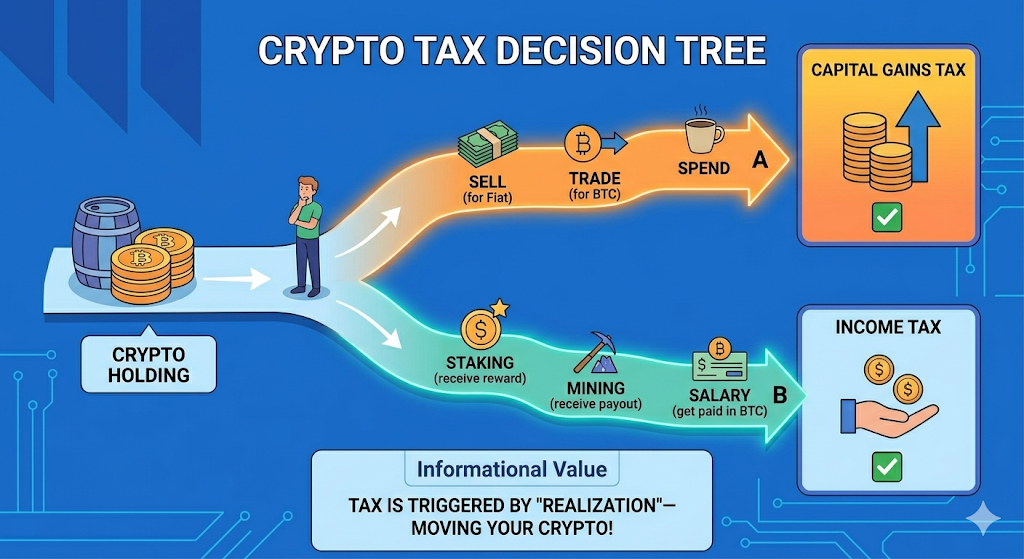
In general, taxable crypto events include selling, trading, spending, or earning crypto and you pay taxes when you make a profit or earn crypto income.
In most countries, including the U.S., UK, and Canada, crypto is treated as property or something similar. This means you owe capital gains tax whenever you “dispose” of it, which includes selling for cash, swapping one coin for another, or spending it on a coffee. Basically, your taxable profit is simply the difference between your buying price and the value when you moved it.
If you receive crypto as a reward or payment, governments usually tax it as regular income based on its value when you receive it. This applies to:
- Staking rewards and mining payouts
- Airdrops and referral bonuses
- Getting paid a salary in crypto
There are some exceptions where crypto taxation by country varies. For example, India applies a flat 30 percent tax plus 1 percent TDS with no loss offset. Meanwhile, Portugal and Singapore offer conditional tax benefits depending on activity.
How Does Crypto Taxation Differ By Country?
Globally, crypto taxes fall into three main buckets: tax-free, low-tax, and high-tax zones.
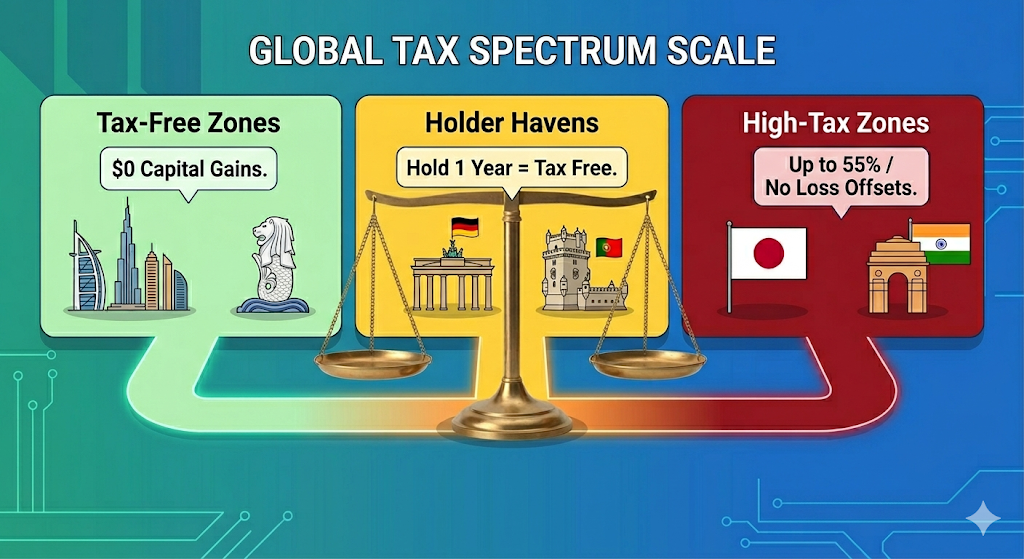
In “safe havens” like the UAE, there is no personal income tax on gains, while Singapore avoids capital gains tax unless your high-frequency trading looks like a professional business.
Other nations prefer rewarding long-term holders. For instance, Germany and Portugal typically offer tax-free gains if you hold your assets for over a year, and Switzerland avoids capital gains tax for private investors in favor of a small annual wealth tax.
On the stricter end of the spectrum, countries like India impose a flat 30% tax and a 1% TDS on every trade without allowing for loss offsets. Japan treats crypto as miscellaneous income with rates reaching up to 55%, while the Netherlands uses a unique “presumed gain” model that taxes you on the total value of your assets regardless of whether you actually sold them.
Because there is no unified global framework, your tax bill depends entirely on where you live and how long you hold. We have also covered how investors think about moving to more favorable jurisdictions, when that strategy makes sense, and when it does not. Check it out here.
How Is Crypto Taxed in Different Countries?
We’ve created separate guides that explain crypto tax rules for each country. You can browse the full list of crypto tax guides to learn more. But here’s a quick snapshot of how each country taxes crypto:
Finland
Finland taxes crypto as capital income at 30 percent up to €30,000 and 34 percent above. Losses are deductible. Mining is taxed as earned income. Check out our in-depth guide on Finland crypto taxes to learn more.
Canada
Canada treats crypto as a commodity. They only tax 50% of your crypto capital gains, but they can tax 100% of your profits if your trading activity qualifies as a business. Check out our in-depth guide on Canadian crypto taxes to learn more.
Spain
Spain uses a progressive capital gains tax on crypto, ranging from 19% to 28% depending on the size of your gain. They require investors to declare foreign crypto holdings above €50,000 through a form called Modelo 721. Check out our in-depth guide on Spanish crypto taxes to learn more.
India
India imposes a flat 30 percent tax on gains plus 1 percent TDS per transaction. Losses cannot be offset. This is one of the strictest crypto tax rates by country. Check out our in-depth guide on Indian crypto taxes to learn more.
Dubai (UAE)
Dubai remains one of the most popular destinations for crypto investors globally. The UAE doesn’t impose income or capital gains taxes for individuals on crypto. Businesses earning corporate crypto profits above AED 375,000 face a 9% corporate tax. Simply visiting doesn’t give you the tax benefits. You need to actually establish residency, for which you can read this guide.
United States
The US treats crypto as property under IRS rules. The U.S. taxes short-term crypto gains at ordinary income tax rates of 10%–37%, while long-term gains are taxed at 0%–20% based on income. Staking rewards are taxed as income at receipt. Check out our in-depth guide on the US crypto taxes to learn more.
Italy
Starting in 2026, Italy taxes all crypto capital gains at 33%, with no minimum threshold. You also owe a 0.2% annual wealth tax on your total holdings. Alternatively, you can choose a one-time 18% tax on your entire portfolio’s value to “reset” your cost basis, which may save you money if you have large unrealized profits. Check out our in-depth guide on the Italian crypto taxes to learn more.
Portugal
If you sell your crypto within a year, you have to pay tax on the profit, which could be up to 48%. But, if you hold onto your crypto for longer than a year, you pay no taxes. Check out our in-depth guide on Portuguese crypto taxes to learn more.
Romania
Romania applies a 10% tax on gains. Small gains under 200 RON per transaction may be exempt within limits. Check out our in-depth guide on Romanian crypto taxes to learn more.
United Kingdom
In the UK, crypto gains are taxed at 18% or 24%, based on your income. You get a £3,000 yearly tax-free limit. Staking and mining rewards count as income and are taxed at your usual income tax rate. Check out our in-depth guide on the UK crypto taxes to learn more.
Brazil
Brazil taxes monthly gains above BRL 35,000 at rates from 15 percent to 22.5 percent. Gains below that monthly threshold are not taxed. Check out our in-depth guide on Brazilian crypto taxes to learn more.
South Africa
South Africa treats crypto as an asset. Capital gains tax applies up to an effective 18 percent, while trading income can be taxed up to 45 percent. Check out our in-depth guide on the South African crypto taxes to learn more.
Malaysia
Malaysia generally does not tax casual crypto investments. However, frequent trading may be classified as business income and taxed accordingly. Check out our in-depth guide on Malaysian crypto taxes to learn more.
Japan
Japan has long had some of the highest crypto taxes, with gains treated as miscellaneous income and taxed up to 55%.
That’s starting to change.
In December 2025, Japan’s ruling coalition backed a plan to move to a flat 20% tax on crypto gains from spot trading, derivatives, and ETFs on registered exchanges. The reform also allows losses to be carried forward for three years. Final approval is still pending, with full rollout expected around 2027. However, staking rewards will still be taxed as miscellaneous income, up to 55%.
Check out our in-depth guide on Japanese crypto taxes to learn more.
Sweden
Sweden applies a flat 30 percent capital gains tax. Loss deductions are limited to 70%. Check out our in-depth guide on Swedish crypto taxes to learn more.
Netherlands
The Netherlands is an unusual case. Rather than taxing actual gains, the Netherlands taxes crypto under a deemed wealth return system (Box 3), which taxes an assumed return on your assets rather than what you actually made. Effective rates typically fall in the range of 0.5% to 1.7% of your holdings annually. Check out our in-depth guide on Netherlands crypto taxes to learn more.
Denmark
Denmark taxes gains as personal income up to 52%. Check out our in-depth guide on Danish crypto taxes to learn more.
France
France applies a flat 30% tax (PFU) on crypto gains for individuals. Professional traders may face higher rates. Check out our in-depth guide on French crypto taxes to learn more.
Germany
In Germany, crypto held over one year is tax-free, while short-term gains are taxed at income rates up to 45%. Check out our in-depth guide on German crypto taxes to learn more.
Austria
Austria taxes crypto at a flat 27.5% capital gains rate. Check out our in-depth guide on Austrian crypto taxes to learn more.
Ireland
Ireland applies a 33% capital gains tax. Income tax applies to mining and staking rewards. Check out our in-depth guide on Irish crypto taxes to learn more.
Australia
Australia treats crypto as property. Capital gains tax applies, with a 50% discount for assets held over 12 months. Tax rates for the remaining gain range from 0% to 45% depending on your income. Check out our in-depth guide on Australian crypto taxes to learn more.
Switzerland
Private investors pay no capital gains tax, but a wealth tax applies annually. Professional traders are taxed as income. Check out our in-depth guide on Swiss crypto taxes to learn more.
How Are Different Crypto Activities Taxed Globally?
Advanced activities follow the same core logic of how crypto is taxed globally. You pay income tax when you receive rewards and capital gains tax when you sell later. However, areas like DeFi and NFTs are less standardized, so crypto tax regulations global can vary widely depending on the activity.
How Is Staking Taxed Globally?
Staking rewards are usually taxed as income based on their market value when you receive them, similar to earning interest. If you sell those tokens later, capital gains tax may apply on any increase in value, which can feel like double taxation. Read our staking guide to learn more.
How Are Crypto Airdrops and Forks Taxed Worldwide?
Airdrops and forks are typically taxed the same way, counted as income when received, with capital gains tax applied if their value rises before you sell.
How Are DeFi Transactions Taxed?
DeFi taxes are less clear. Activities like lending, liquidity pools, and yield farming can trigger multiple taxable events in a single transaction, making tax tracking more complex. Read our in-depth guide on DeFi taxes to learn more about its complexities.
How To Stay Compliant With Crypto Tax Worldwide?
To stay compliant with crypto tax worldwide, you need accurate records, a clear understanding of local cryptocurrency tax rules, and consistent reporting. Most penalties don’t happen because people try to cheat. They happen because of poor tracking and missing data.
Start with tracking. Every buy, sell, swap, or reward can be a taxable crypto event. That includes crypto-to-crypto trades like swapping ETH for SOL, which many people forget to report. You need timestamps, fair market values, fees, and wallet addresses for every transaction. Without this data, calculating gains or income becomes unreliable. Weak recordkeeping is the single biggest source of tax mistakes.
Doing this manually becomes overwhelming once you use multiple wallets or exchanges. Many investors use crypto tax software like Bitcoin.Tax, which automatically pulls transaction history across platforms, calculates gains, losses, and taxable income, converts values into local currency, and generates reports compatible with filing tools like TurboTax or TaxACT.
Next, understand your local laws. Many mistakes come from assuming rules are the same everywhere or that crypto is tax-free by default. While organizations like the Organisation for Economic Co-operation and Development are pushing global reporting standards, enforcement still depends on your country.
Finally, consult a tax professional if your activity includes staking, DeFi, NFTs, or frequent trading, where multiple taxable events can happen quickly and small reporting gaps can compound into larger issues.
Quick checklist:
- Track every transaction
- Classify income vs capital gains
- Use reliable tax software, like Bitcoin.Tax
- Check country-specific rules
- File reports on time
Frequently Asked Questions (FAQs)
How Are Crypto-to-Fiat Withdrawals Taxed When You Cash Out?
Whenever you trade crypto for fiat currency like USD or EUR, it’s considered a “disposal.” In most regions, including the U.S. and UK, you owe capital gains tax on the profit, the difference between your original purchase price and the cash-out value. It is a common misconception that taxes only apply when you move money to a bank; in reality, the tax is triggered the moment the trade happens on the exchange.
Do You Still Owe Taxes If You Lose Money in Crypto?
In many countries, you can use losses to “offset” your gains, which lowers your overall tax bill. However, rules vary wildly by location. For example, India does not allow you to offset losses at all, meaning you are taxed on every profitable trade even if your total portfolio is down. Always check your local laws to see if “tax-loss harvesting” is an option for you.
How to Report Crypto Taxes Internationally If You Use Multiple Exchanges?
If you trade across various wallets, DEXs, and exchanges, you must consolidate every single transaction into one master report for your local tax authority. Because manual tracking is nearly impossible for active traders, most people use crypto tax software to aggregate their data. With global transparency rules now in full effect, keeping accurate, unified records is the only way to avoid audits and penalties.