Why Are Crypto Gas Fees High & What To Do About it?
Have you ever wondered why are crypto gas fees so high? Well, it’s because gas fees rise when many users compete for limited block space, and validators prioritize transactions that pay higher fees. Complex transactions also need more computing power, which increases the gas cost even further.
Data from YCharts shows that average Ethereum gas fees have crossed $60 during high-demand periods. This volatility makes it harder for everyday users and investors to plan transactions or manage costs.
So what actually causes these spikes, and more importantly, how can you avoid them? In this guide, we break down why Ethereum gas fees are so high, how they work behind the scenes, and practical ways to reduce what you pay.
What Are Crypto Gas Fees?
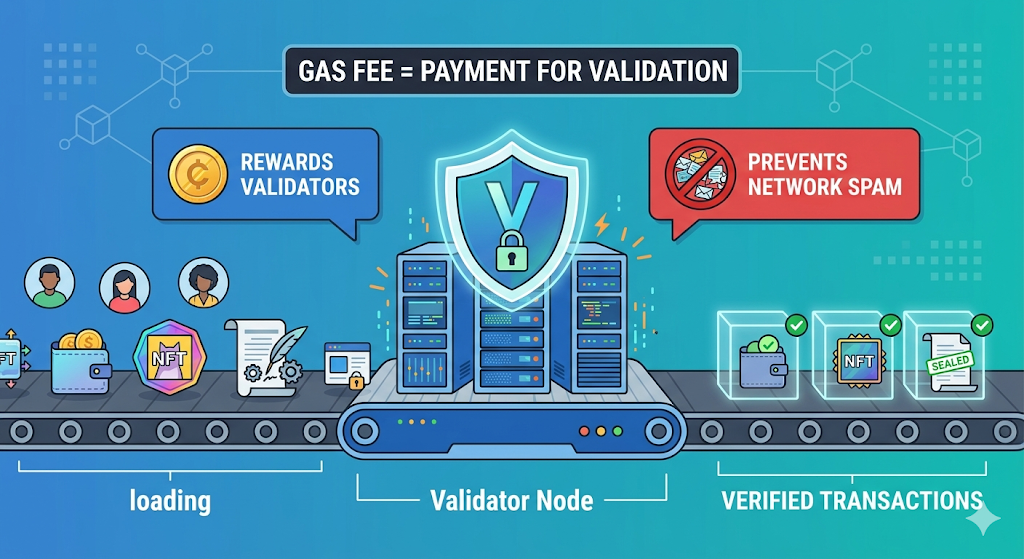
Crypto gas fees are the costs you pay to execute a transaction or run a smart contract on a blockchain. In simple terms, they are the price of using the network. These fees go to validators, help secure the system, and manage demand for limited block space.
Anytime you send crypto or run a smart contract, like minting an NFT or using a DeFi app, the network has to process and record your request. Gas fees pay validators for doing that work and help keep the system running.
These fees exist for two main reasons: to reward validators and to prevent spam. Validators use computing power and electricity to verify transactions and add them to blocks. Gas fees act as payment for that work. They also make it expensive to flood the network with useless transactions, which helps keep the system secure and usable.
Gas fees also help manage limited block space. Each block can only hold a certain number of transactions, so when many people are trying to use the network at once, fees rise. Users who pay higher fees usually get processed faster.
You’ll see gas fees most on smart contract platforms like Ethereum, where transactions involve running code, not just sending payments. Unlike traditional transaction fees, which are often fixed, gas fees change based on how much work your transaction requires and how busy the network is.
How Do Crypto Gas Fees Work?
Crypto gas fees are calculated using two parts: how much work your transaction needs and how much you are willing to pay for that work. The formula for this looks like this:
Total gas fees = Gas limit x Gas price.
The formula is straightforward and reflects both computational effort and market demand. But the pricing changes constantly based on network demand.
Gas Limit
Start with a gas limit. This is the maximum amount of computational work your transaction can use. A simple ETH transfer needs less gas. A complex DeFi swap or NFT mint needs more because it runs more code. This is often called transaction complexity or smart contract execution cost.
Gas Price
Next is gas price. This is what you pay per unit of gas. It is usually measured in Gwei, which is just a tiny fraction of ETH. One Gwei equals 0.000000001 ETH.
Today, Ethereum uses an updated system introduced through EIP-1559, which adjusts fees dynamically.
What Is the EIP-1559 Gas Fee Model and How Does It Work?
The EIP-1559 gas fee model changed how Ethereum calculates fees by splitting them into a base fee and a priority fee. The base fee is automatically set and burned, while the priority fee is a tip paid to validators. It made Ethereum gas fees more predictable, but it did not solve the problem of high costs when the network is busy.
Base Fee
The Base Fee is the minimum price required to get onto the blockchain. It adjusts automatically based on how busy the network is, rising when blocks are full and falling when they are empty. Instead of going to validators, this fee is “burned,” meaning the ETH is permanently destroyed. This helps stabilize prices and makes costs much more predictable for regular users.
Priority Fee
The Priority Fee is an optional tip you pay directly to validators. If you’re in a rush, a higher tip encourages them to process your transaction faster. While this new structure makes fees easier to calculate, it hasn’t actually lowered the prices. During times of extreme demand, the base fee still spikes, which is why Ethereum can still feel expensive during peak hours. Together, these two parts offer a more transparent way to navigate the network without having to overpay just to be safe.
Why Are Crypto Gas Fees High?

Crypto gas fees get high mainly because too many users compete for limited block space, especially on Ethereum. Each block has a strict gas limit, so when demand rises, users compete to get their transactions included. Ethereum processes over 1 million transactions daily, and during busy periods gas prices have jumped from under 20 Gwei to over 200 Gwei, even crossing 500 Gwei during events like the 2021 NFT boom. That’s basic supply and demand in action.
Large spikes usually come from DeFi platforms, NFT launches, and other dApps. A single popular NFT mint can flood the network with transactions. For example, the Otherside NFT sale alone burned over $150 million in gas fees, with some users paying up to 2.6 ETH, around $7,000, for one transaction. Even under normal congestion, NFT minting fees can range from $50 to $500.
Transaction complexity also plays a big role. A simple ETH transfer uses about 21,000 gas units, but more complex actions, like swapping tokens on a DeFi platform, can require 100,000 gas units or more. More computation means more gas, which is why interacting with smart contracts usually costs more than sending ETH.
Before transactions are confirmed, they sit in the Ethereum mempool, where users compete by offering higher fees to get priority. This creates bidding wars. On top of that, MEV (Maximal Extractable Value) bots scan the mempool and submit higher-fee transactions to capture trading opportunities. Their activity adds extra congestion and pushes gas fees even higher, especially during volatile market conditions.
These are all reasons contributing to high gas fees in crypto.
Why Are Ethereum Gas Fees Higher Than Other Blockchains?
Ethereum’s higher gas fees are the result of an intentional trade-off: the network prioritizes security and decentralization over raw transaction speed. By spreading control across thousands of global validators, Ethereum ensures the network is nearly impossible to hack or shut down, but this “Layer 1” design limits how many transactions can fit into each block. When demand is high, users must outbid each other to get processed, driving prices up.
In contrast, other blockchains use different scaling strategies to keep costs low. Solana achieves sub-cent fees by processing thousands of transactions per second through a high-speed, monolithic architecture. BNB Chain maintains fees typically under $0.50 by using a smaller, more centralized set of validators to increase efficiency. Meanwhile, Polygon functions as a “Layer 2” sidechain, batching transactions together to settle on Ethereum for just a few cents.
How Can You Reduce Crypto Gas Fees?
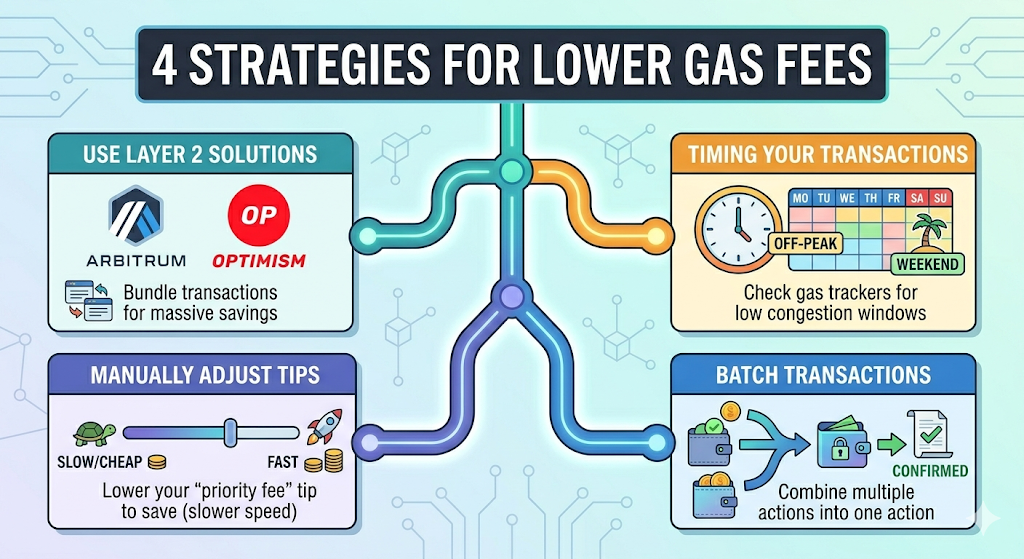
You can reduce crypto gas fees by switching to cheaper networks, timing your transactions better, adjusting fee settings, and avoiding unnecessary on-chain actions. The most effective method is moving to Layer 2 solutions like Arbitrum, Optimism, or zk-Rollups. These networks bundle transactions together before settling them on Ethereum, often slashing a $30 fee down to under $1 without sacrificing the underlying security.
For those staying on the main network, timing is everything. By using gas trackers like Etherscan to avoid peak hours and bidding wars, you can save a fortune just by waiting for a quieter window. You can also manually lower your “priority fee” (the tip to validators), though this comes with the risk of your transaction being delayed or stuck if the network gets suddenly busy. Finally, you can optimize your costs by batching transactions, combining multiple actions into one, or using more gas-efficient protocols.
By combining these strategies, you can navigate the ecosystem without overpaying for every move. If you’re looking for a deeper dive into these techniques, be sure to check out our previous in-depth guide on how to reduce Ethereum gas fees for a step-by-step breakdown.
Frequently Asked Questions (FAQs)
When are gas fees lowest on Ethereum?
Fees are lowest when network demand drops, typically during late-night hours (UTC) and weekends when global trading and DeFi activity slow down. Data from Etherscan consistently shows that these off-peak windows offer the cheapest block space. Beyond timing, calm market conditions are key; during periods of low volatility, fewer people are rushing to trade or mint, which reduces congestion and keeps costs significantly lower compared to busy weekdays or sudden market rallies.
Can crypto gas fees ever go to zero?
No, crypto gas fees cannot realistically go to zero. Every blockchain needs some form of fee to prevent spam and reward validators. Even with scaling solutions like rollups, there is still a cost for computation and network security. On Ethereum, fees may become very low over time, but they will not disappear entirely.
Why do failed transactions still charge gas fees?
Gas fees are charged for the computational work performed, not just for successful outcomes. Even if a transaction fails, validators still process it, verify conditions, and use network resources. For example, if you interact with a smart contract and it runs out of gas or hits an error, the work has already been done. That is why you still pay. This is a key part of how gas fees work and ensures the network is protected from spam or malicious activity.
Are Layer 2 gas fees always cheaper than Ethereum’s mainnet?
Most of the time, yes, but not always. Layer 2 networks like Arbitrum and Optimism are usually much cheaper because they process transactions off-chain. However, during extreme demand or when bridging assets between networks, costs can temporarily rise. Still, they remain significantly lower than typical Ethereum gas fees in most cases.
Are crypto gas fees tax deductible?
Not exactly. For regular investors, gas fees aren’t a standalone deduction, but they still save you money on taxes. When you buy crypto, the fee is added to your cost basis, and when you sell, it’s subtracted from your proceeds. This effectively reduces your taxable capital gain. However, if you’re running a professional mining or staking business, you may be able to deduct gas as a direct business expense.