Crypto Mining Earnings: How Much Can You Realistically Earn?
Crypto mining earnings are the real profits miners keep after accounting for electricity costs, hardware depreciation, downtime, and taxes. While gross rewards may look high, actual earnings vary widely and are often much lower once real-world expenses are included.
Crypto mining earnings look incredible on paper, until the bills and taxes show up. Most people researching mining profitability run into the same problem: flashy calculators, YouTube screenshots, and blog posts that focus only on gross rewards. Electricity costs get brushed aside. Taxes are ignored completely. And the result is expectations that don’t survive the real world.
According to industry estimates, electricity alone can consume 40–70% of mining revenue, and in many countries, mined crypto is taxed as income the moment it’s earned.
This article is written for miners and investors who want clarity, not hype. If you’re trying to decide whether mining is worth your money, time, and electricity, this guide will help you make that call with eyes open.
How Crypto Mining Earnings Actually Work
Crypto mining is how transactions get verified and new coins get created. Blockchains like Bitcoin need someone to confirm that transactions are legitimate. Miners do that work by solving complex math problems using specialized computers.
Every time a miner solves one of these problems, they add a new “block” of transactions to the blockchain. Think of a block like a page in a ledger. Once it’s added, those transactions become permanent and can’t be changed.
Now, here’s where the money comes in.
Miners earn crypto in two ways.
First, block rewards. This is new crypto created as a reward for adding a block to the blockchain. For Bitcoin, that reward started at 50 BTC per block. But it gets cut in half roughly every four years, a process called “halving.” The most recent halving dropped the reward to 3.125 BTC per block. That’s why crypto mining profitability changes over time, even if prices stay flat. Fewer coins per block means less income per block.
Second, transaction fees. Every transaction includes a small fee paid by the sender. When networks are busy, fees spike and boost crypto mining income. When activity slows, fees shrink. Think of it like surge pricing. Busy hours pay more.
Most retail miners don’t mine alone. That’s where pool payouts come in.
Solo mining vs pool mining

Mining requires expensive, specialized hardware, ASICs for Bitcoin or high-end GPUs for other coins. These machines cost thousands and consume massive electricity. Your hardware’s processing power is measured in “hash rate”, how many guesses per second your machine makes to solve blocks.
Here’s the problem: you’re competing against warehouses full of ASICs churning out trillions of hashes per second. Solo mining with one machine means you might mine for months without earning a block. You’re still paying electricity while earning nothing.
Pool mining fixes this.
You combine your hash power with other miners. When anyone in the pool solves a block, the reward splits based on contribution. Your hardware stays yours, you just point it at the pool’s server.
Result? Steady, small payouts instead of waiting months for a reward that might never come. For realistic crypto mining profits, pools make more sense.
Why hash rate, difficulty, and uptime matter
Hash rate is your work speed, how fast your hardware can solve problems. Higher hash rate means more chances to earn.
Network difficulty adjusts based on how many miners are active. Think of it like this: when more people show up to compete, the problems get harder. That means crypto mining earnings drop unless you upgrade your hardware.
Uptime is how often your rig is actually running. If your machine goes offline 10% of the time, whether from crashes, maintenance, or power outages, you lose 10% of your potential crypto mining income. Consistent operation matters.
Average Crypto Mining Income: Realistic Numbers (Before Taxes)
When people ask how much money do crypto miners make, the honest answer is: it varies widely depending on hardware, coin, electricity costs, and scale.

Average Earnings Per Month and Per Year
If you plug a typical ASIC miner into a crypto mining profitability calculator, you can get rough estimates based on current difficulty and prices. For example, a popular Bitcoin ASIC might show around $400–$500/month in revenue before electricity costs, and $5,000–$6,000/year in revenue under ideal conditions.
Keep in mind: those figures are before electricity costs. After power bills, profit drops significantly.
ASIC vs GPU Mining Income Comparison
ASIC miners (Application-Specific Integrated Circuits) are custom machines built for specific coins like Bitcoin. They tend to earn more per machine because they offer high hash rate per watt. ASIC income estimates often have daily profits in the $15–$40 range per device before electricity, depending on coin and difficulty.
GPU rigs, on the other hand, can mine a variety of altcoins. But after the Ethereum transition away from PoW, most GPUs are less profitable overall since they must switch between smaller coins with lower rewards. GPU mining can still be decent, but per-unit income is usually lower and more volatile than ASIC rigs.
Home Mining vs Hosted/Industrial Mining
Home crypto mining profits are usually lower than industrial setups because home miners pay retail electricity rates of roughly $0.10–$0.20 per kWh. At those rates, a single home ASIC typically earns only a few tens to a few hundred dollars per month before electricity and other costs, depending on difficulty and price. Industrial and hosted miners, by contrast, secure utility or wholesale power that is often 30–50% cheaper than residential pricing, which materially improves profit per machine and long-term viability
Why Income Varies Drastically
Several things impact crypto mining income:
- Electricity cost per kWh
- Network difficulty and coin price
- Hash rate of your hardware
- Pool fees and downtime
Even using the same rig, one miner in a cheap-power region can make much more than another in a high-cost region. That’s why average numbers are just a starting point.
How Much Does it Cost to Mine Crypto? (Full Crypto Mining Expenses Breakdown)
Understanding crypto mining profitability after expenses means going beyond just revenue. You have to count every cost that drains your crypto mining income after taxes.
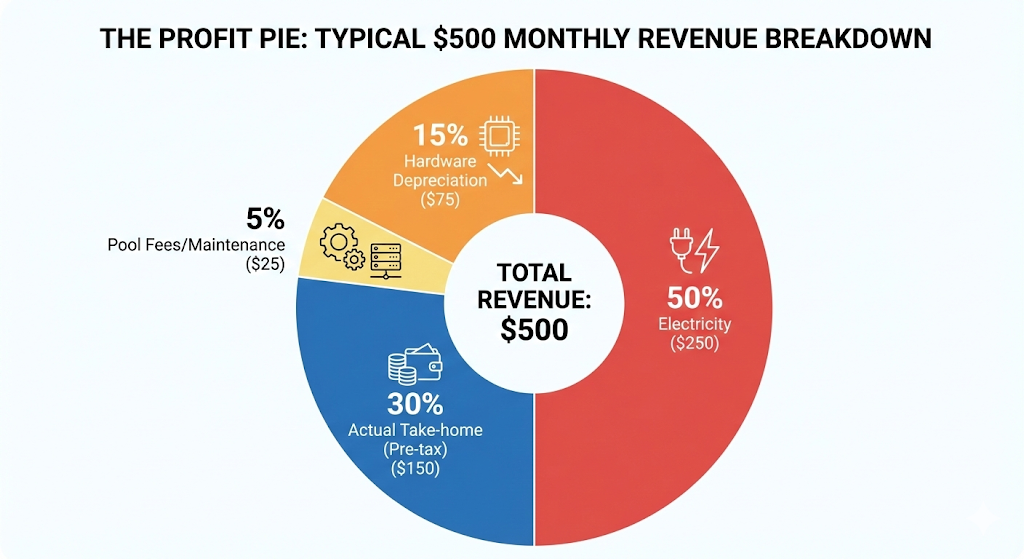
Electricity Costs (Global Averages + Sensitivity to kWh Pricing)
Electricity is the biggest expense for most miners. Miners run 24/7, and every watt adds up.
- In cheap-power regions (like parts of China, the Middle East, or rural U.S.), costs can be $0.05–$0.08/kWh.
- In high-rate areas (Europe, Japan, parts of India), rates can hit $0.15–$0.25/kWh or more.
Even a small change in kWh can swing your net crypto mining income dramatically. For example:
- A miner that draws 1,500 W (1.5 kW) running 24 hrs uses ~36 kWh/day.
- At $0.05/kWh, that’s ~$1.80/day in electricity.
- At $0.20/kWh, that’s ~$7.20/day (a 4× cost jump)
Hardware Costs and Depreciation
ASICs and GPUs can cost hundreds to thousands of dollars each.
- A decent ASIC might cost $2,000–$12,000 new.
- GPU rigs vary a lot, but a 6-GPU setup can easily hit $3,000+.
You must depreciate that cost over the useful life of the machine. Most miners assume:
- 1–2 years for ASICs
- 1–3 years for GPU rigs
So every month you should treat part of that cost as an expense.
Pool Fees, Cooling, Maintenance, Downtime
Most retail miners use mining pools. Pools charge fees, usually 1–3% of earnings. That lowers your crypto mining earnings directly.
Then there’s cooling and maintenance:
- Fans, repairs, parts replacement.
- Downtime when rigs are offline (power cuts, hardware failures).
Even a few hours offline each week can cut your monthly income noticeably. Think of this like a hidden tax on uptime.
Hidden Costs Most Miners Ignore
Many miners forget these:
- Networking and router uptime costs
- Electric panel upgrades
- Fire safety equipment
- Cabinet or rack storage
- Tax preparation or accounting fees
These don’t show up in simple profitability calculators but reduce your crypto mining ROI after taxes.
In short, real crypto mining expenses breakdown shows that electricity, hardware wear, and incidental costs often take 40–70% of gross earnings before you even think about taxes.
How Crypto Mining Is Taxed
If you want realistic crypto mining income after taxes, you need to understand how mining rewards are taxed. Check out our in-depth guide crypto mining taxes to learn more, but here’s a quick primer:
When Mined Crypto Becomes Taxable Income
As soon as you successfully mine a coin, most tax authorities view that reward as ordinary income. That means the fair market value of the coin on the day you receive it counts as income for that tax year. You don’t wait until you sell it, the moment your rig earns it, it’s a taxable event.
This applies whether you mine as a hobby or more professionally. Once you record it as income, that value becomes your cost basis for future capital gains calculations.
Income Tax vs Capital Gains Tax
Two separate taxes usually apply:
- Income Tax:
- This hits your mining rewards as soon as they are earned.
- You report this like wages or business income.
- Capital Gains Tax (CGT):
- This applies when you later sell, swap, or spend the coins you mined.
- Tax is on the gain, not the entire sale amount. Gain = sale price – cost basis.
- Many countries (like the UK, US, Canada, etc.) tax disposals under CGT rules.
So you can be taxed twice: once when you mine it and again when you sell it, unless local rules say otherwise.
Tax Treatment Differences by Country
Tax laws vary quite a bit:
- United States: Mining income is treated as ordinary income. Later sales → capital gains tax.
- United Kingdom: HMRC treats mined crypto as income, and selling triggers CGT above the annual allowance.
- India: Crypto is treated as a “virtual digital asset.” Mining may be taxed as business or hobby income at your slab rate. Selling later triggers a flat 30% tax on gains plus possible TDS.
Check out our country-wise crypto tax guides.
This variation means your realistic crypto mining profits depend heavily on where you live.
This is why holding vs selling matters. Mining creates an immediate income tax liability, even if you don’t cash out. Capital gains tax only applies when you sell, swap, or spend the coins.
Mine → income tax.
Sell later → capital gains tax.
Together, these can significantly reduce your net crypto mining income without proper planning.
Crypto Mining Income After Taxes
Now let’s put everything together and look at crypto mining income after taxes in real-world scenarios.
Small-Scale Home Miner (GPU Setup)
Assume a home miner running a modest GPU rig.
- Monthly mining revenue: ~$180
- Electricity cost: ~$90
- Pool fees & misc: ~$10
That leaves $80/month as taxable profit, assuming electricity and fees are deductible business expenses.
Now apply taxes. If that $80 is taxed at 25%, the tax owed is ~$20.
Net result:
- Net monthly income: ~$60
- Net yearly income: ~$720
Even with correct deductions, home crypto mining profits remain thin. A spike in electricity rates, higher difficulty, or a few days of downtime can quickly erase profits. That’s why small-scale miners often operate close to break-even and feel the pressure fastest when conditions worsen.
Mid-Scale ASIC Miner Example
Now let’s look at a more serious setup. One modern ASIC miner running continuously.
- Monthly mining revenue: ~$550
- Electricity cost: ~$220
- Pool fees & cooling: ~$25
That leaves ~$305/month as taxable profit, assuming electricity and operating costs are deductible.
If your income tax rate is 30%, the tax owed is ~$92.
Net result:
- Net monthly income: ~$213
- Net yearly income: ~$2,560
This is a more accurate picture of small-scale crypto mining earnings that actually survive after expenses and taxes. It’s profitable on paper, but still sensitive to electricity rates, downtime, and rising network difficulty, which can quickly stretch ROI timelines.
Monthly vs Yearly Net Profit Reality
Here’s the key takeaway:
- Monthly profits often look “okay” on paper.
- Yearly profits expose the truth.
Hardware depreciation, rising difficulty, and taxes slowly eat away at realistic crypto mining profits. Many miners break even only after 12–18 months, if prices cooperate.
What This Means for Profitability
After electricity and taxes, crypto mining profitability is far lower than most calculators suggest. Mining can still pay off, but only if:
- Electricity is cheap
- Uptime is high
- Taxes are planned for
Otherwise, how much can crypto miners earn shrinks fast once the bills and taxman show up.
Does Crypto Mining Still Pay Off?
So, is crypto mining still profitable after time, costs, and taxes? Using the corrected figures:
- Home GPU miner:
~$60 net/month on a $1,200–$1,500 setup → ~20–25 months to break even - Mid-scale ASIC miner:
~$210 net/month on a $3,000–$4,000 machine → ~14–18 months to break even
These timelines assume stable prices and no major downtime. In reality, rising network difficulty often slows returns further. If difficulty grows faster than price, daily earnings fall and crypto mining profitability stretches out even more.
Mining can still pay off, but ROI is slow, uneven, and easy to overestimate.
Mining ROI After Taxes vs Pre-Tax Projections
Most calculators are misleading because they ignore taxes. Pre-tax ROI looks good, but taxes usually cut returns by 20–40%, often adding 6–12 months to break even. That’s why crypto mining earnings on paper rarely match reality.
Why Many Miners Quit Early
Miners quit because costs stay fixed while income fluctuates. Higher electricity bills, hardware wear, and unpaid tax liabilities quickly eat into realistic crypto mining profits.
Mining vs Buying Crypto: Which Is More Profitable After Taxes?
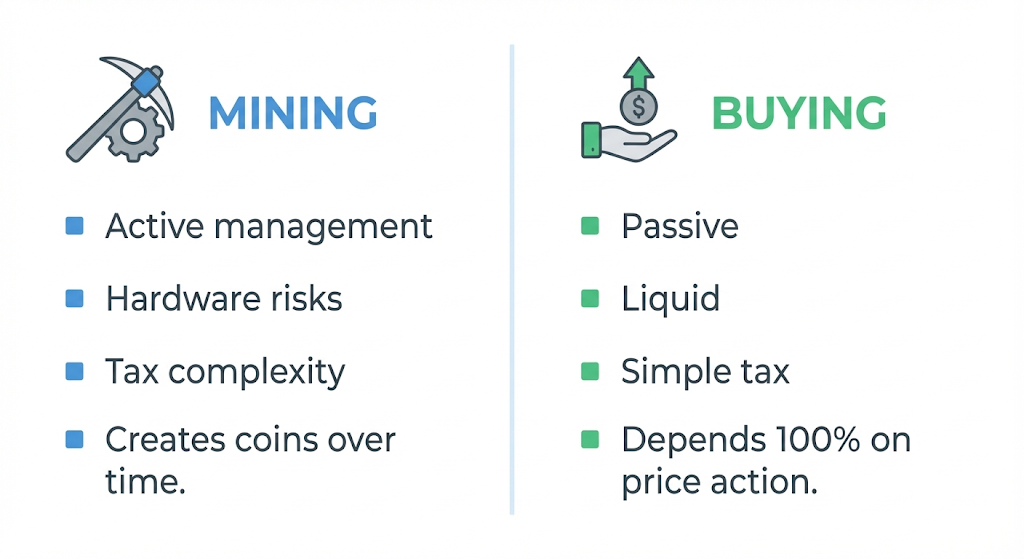
Many people eventually ask whether mining is worth it, or if it’s simpler to just buy crypto. The difference comes down to structure. Mining requires upfront spending on hardware and ongoing electricity costs, and that capital is locked into machines that lose value over time. Buying crypto is more straightforward. You invest directly in the asset, with no maintenance, no power bills, and full liquidity.
Taxes widen the gap. Mining rewards are usually taxed as income when earned, and may be taxed again if you sell later at a higher price. Buying crypto, on the other hand, typically triggers tax only when you sell. That makes crypto mining income after taxes less efficient for many people. Mining generally makes sense only if you have cheap electricity, reliable uptime, and are comfortable treating it like a long-term business rather than a passive investment.
Tools to Calculate Crypto Mining Profitability Accurately
If you want a realistic view of crypto mining profitability, calculators are useful, as long as you know which ones to trust and what they leave out.
Profitability calculators (before tax):
- NiceHash Profitability Calculator – quick estimates using hash rate and power usage
- Minerstat Mining Calculator – detailed ASIC and GPU earnings comparisons
- WhatToMine – widely used for GPU mining profitability and coin switching
Electricity & hardware ROI calculators:
- ASIC Miner Value – estimates revenue, power costs, and payback period for ASICs
- Hashrate.no – efficiency comparisons across miners and GPUs
- MiningPoolStats – network difficulty and reward tracking
Crypto tax calculators for miners:
These tools help estimate net crypto mining income, but none are fully accurate. Prices change, difficulty adjusts, hardware fails, and tax rules evolve. Use calculators to model ranges, not guarantees, and always stay conservative when estimating how much you can realistically earn mining crypto.
What are the Risks that Impact Long-Term Mining Profits
Even if mining looks profitable today, long-term crypto mining profitability is shaped by risks you can’t control.
- Rising network difficulty: As more miners join and hardware improves, the same machine earns less over time. Income rarely stays stable.
- Bitcoin halving: Every four years, block rewards are cut in half. Revenue drops immediately, while price increases, if they happen, usually come later.
- Regulatory and tax changes: Governments can raise tax rates, change how mining is classified, or restrict mining activity, directly reducing crypto mining income after taxes.
- Hardware obsolescence: Newer, more efficient miners quickly make older rigs unprofitable. Power costs rise relative to output, and resale value falls fast.
Frequently Asked Questions
Can crypto mining losses be used to offset other income for tax purposes?
In some countries, mining losses can be treated as business losses and used to offset other taxable income, but only if mining qualifies as a business activity. Hobby miners usually don’t get this benefit. The rules vary widely by jurisdiction.
Are mining rewards taxed differently if paid in stablecoins?
Generally, no. Stablecoin payouts are still treated as income at face value. The difference is reduced price volatility, which can simplify capital gains calculations later.
Does mining through a company or LLC change profitability significantly?
It can. A formal business structure may allow deductions for electricity, hardware depreciation, and maintenance. However, it also adds compliance, accounting costs, and potential corporate taxes, which can offset those benefits.