What is BNB Chain: How It Works, Fees, Taxes & more
BNB Chain is a fast, low-cost Layer 1 blockchain built to run smart contracts, DeFi apps, NFTs, and Web3 projects without the high fees you often see on Ethereum. It uses a smaller set of validators to keep transactions quick and affordable, while its native token, BNB, powers fees, staking, and governance across the network.
If you’ve ever tried to make a simple transaction on Ethereum during a busy period and watched the fees climb to $50, $80, or $100, you already know the pain. That’s not a bug. That’s just what happens when too many people are competing to use the same network at once. It gets expensive fast.
BNB Chain was built as a direct answer to that problem. Think of it as a faster, cheaper highway running parallel to Ethereum’s congested roads. It’s a Layer 1 blockchain, meaning it’s its own independent network with its own rules, not built on top of another chain, and it’s backed by the Binance ecosystem, one of the largest crypto exchanges in the world.
So what makes it tick? BNB Chain runs on something called Proof-of-Staked Authority (PoSA), which is basically a hybrid consensus model. Instead of thousands of random validators (like Ethereum), a smaller set of trusted validators take turns confirming transactions. The tradeoff? You get speed and low fees, but some argue it’s more centralized than other blockchains. We’ll get into that.
The network’s native token, BNB, isn’t just a trading asset. It’s used to pay transaction fees, participate in governance (think: voting on network decisions), and staking (locking up tokens to help secure the network and earn rewards).
But cheaper and faster doesn’t automatically mean better. There are real questions worth asking about security, decentralization, investment potential, and yes, taxes. This guide walks you through all of it.
What Is BNB Chain?
BNB Chain is a Layer 1 blockchain network built to support smart contracts, decentralized apps (dApps), and Web3 infrastructure. It was originally launched as Binance Smart Chain (BSC) but later rebranded to BNB Chain to reflect a broader ecosystem vision beyond just Binance. While it is closely related to Binance, the two are not the same entity.
Binance is a centralized crypto exchange (a platform where you buy and sell crypto). BNB Chain is an open blockchain network that anyone can build on. Binance helped create it, but the two operate independently.
BNB Chain is an independent blockchain network, meaning it runs entirely on its own, without relying on Ethereum or any other chain. It supports smart contracts (self-executing code that powers apps and transactions), decentralized apps, DeFi, NFTs, and pretty much everything Web3.
If Ethereum is the original smartphone operating system, BNB Chain is the leaner, faster competitor that runs similar apps at a fraction of the cost.
BNB Beacon Chain Vs BNB Smart Chain
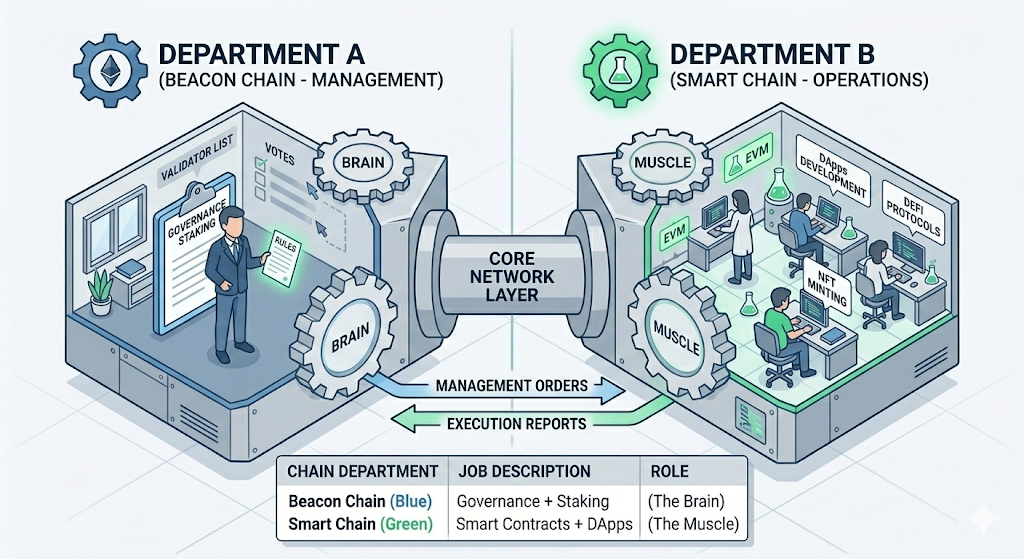
BNB Chain uses a dual-chain architecture made up of BNB Beacon Chain and BNB Smart Chain. The Beacon Chain handles governance and staking, while the Smart Chain powers smart contracts and dApp execution.
The first department is BNB Beacon Chain. This is the management layer. It doesn’t process your transactions or run any apps. Its job is to handle the big-picture stuff. Who gets to validate transactions? How are network decisions made? What are the rules? All of that happens here. Validators, the people responsible for confirming transactions, lock up their BNB tokens here as a kind of security deposit. It keeps everyone accountable.
The second department is BNB Smart Chain. This is where everything you actually use lives. Every app, every token swap, every NFT, and every DeFi transaction. It all runs here. It’s also built to be compatible with Ethereum, which means developers don’t have to start from scratch. If they’ve already built something on Ethereum, they can bring it over to BNB Chain without rewriting everything.
So why have two separate chains at all? Because mixing management with operations slows everything down. Keeping them separate means each chain can focus on what it does best. One handles the rules, and the other handles the speed.
How BNB Chain Works Technically
BNB Chain runs on a consensus model called Proof-of-Staked Authority (PoSA), a hybrid system that blends staking incentives with a reputation-based validator structure. Only 21 active validators run the network at any given time.
Every blockchain needs a way to agree on which transactions are valid, this is called a consensus mechanism. BNB Chain uses one called Proof-of-Staked Authority (PoSA).
Imagine a town that needs people to verify and record every transaction that happens. Instead of letting anyone do it anonymously, the town elects a board of 21 trusted members. These members put up their own money, in this case, BNB tokens, as a guarantee that they’ll do their job honestly. If they cheat or misbehave, they lose that money. That financial risk is what keeps them accountable.
These 21 members are the validators. They take turns confirming transactions and adding them to the blockchain, doing so every 3 seconds. That’s why BNB Chain is so fast.
Now, what if you want to participate but can’t afford to become a validator yourself? You can still delegate your BNB, essentially lending your tokens to a validator of your choice. In return, you get a cut of the rewards they earn. Think of it like being a silent investor in one of those 21 board members.
The whole system is designed so that everyone has something to lose if they act dishonestly and something to gain if they play by the rules.
How Is BNB Chain So Fast and Cheap?
The 21-validator structure is the main reason. Fewer validators mean faster coordination. Getting 21 people to agree is a lot quicker than getting 10,000 to. Blocks confirm every 3 seconds compared to Ethereum’s 12, and larger block capacity means more transactions fit per block, keeping congestion low and fees predictable.
What Is the BNB Token?
BNB is the native token of BNB Chain, its fuel, its backbone, and its governance tool all in one. It started in 2017 as Binance Coin, a simple discount token for trading fees on the Binance exchange. Today it does a lot more.
Ecosystem of BNB Chain
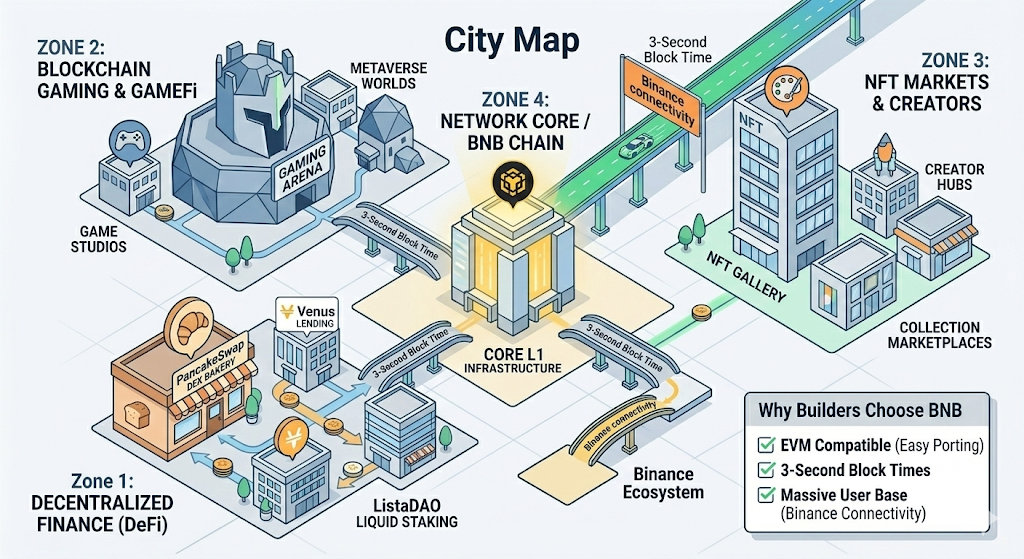
The BNB Chain ecosystem includes DeFi protocols, NFT marketplaces, blockchain games, cross-chain bridges, and wallet integrations built on its Layer 1 infrastructure. It grew rapidly because of low gas fees, fast confirmations, and strong connectivity to the broader Binance Web3 ecosystem.
DeFi is where BNB Chain really accelerated. During peak congestion on Ethereum, users moved to cheaper alternatives. Platforms like PancakeSwap let users swap tokens, provide liquidity, and farm yield at a fraction of Ethereum’s cost. Venus Protocol brought lending and borrowing on-chain, while ListaDAO pushed liquid staking through its slisBNB model.
NFTs and GameFi followed for similar reasons. Lower minting costs allow creators to experiment without heavy upfront fees. Gaming projects benefit from fast block times — real-time mechanics don’t work well if confirmations take 10–15 seconds.
Cross-chain bridges like Stargate Finance extend BNB Chain’s reach by enabling asset transfers across networks. This keeps liquidity fluid rather than siloed.
Getting started is simple. Wallets like MetaMask and Binance Web3 Wallet support BNB Chain natively, so interacting with apps is straightforward. If you want a deeper breakdown of the strongest protocols, our guide to the best DApps on BNB Chain walks through the top platforms by category and real-world usage.
BNB Chain vs Ethereum, Solana, Polygon, Avalanche
BNB Chain offers high speed and low fees through a smaller validator set, while Ethereum prioritizes decentralization, Solana focuses on performance, Polygon scales Ethereum, and Avalanche balances modular design with subnets. Each blockchain makes trade-offs in decentralization, security, developer tooling, and ecosystem maturity.
Ethereum
Ethereum is the gold standard for decentralization, thousands of validators, strong security, and the largest developer ecosystem. The downside? It’s slower and more expensive. BNB Chain trades some of that decentralization for speed and low fees, running just 21 validators instead of thousands. Faster, cheaper, but more centralized by design.
Solana
Solana chases raw performance and pushes significantly higher TPS than BNB Chain, but has faced network outages in the past. Performance at the cost of reliability. Read more about Solana here.
Polygon
Polygon isn’t quite a direct competitor, it’s a Layer 2 scaling solution built on top of Ethereum, not a standalone chain. It inherits Ethereum’s security but depends on it too. Read more about Polygon here.
Avalanche
Avalanche offers a modular approach through its subnet architecture, attracting DeFi builders who want flexibility. It supports a larger validator set than BNB Chain and uses a unique consensus mechanism built for fast finality.
Criticisms & Limitations of BNB Chain
BNB Chain faces criticism for validator centralization, regulatory scrutiny linked to Binance, recurring smart contract exploits in its ecosystem, and rising competition from other Layer 1 blockchains.
The biggest one is centralization. Running on just 21 validators makes the network fast, but it also means decision-making power sits with a very small group. Compared to Ethereum’s thousands of globally distributed validators, that’s a meaningful tradeoff, and critics argue it creates real governance risk.
Then there’s the Binance connection. BNB Chain and Binance are technically separate, but they’re closely associated in public perception. Binance’s recent regulatory actions, including its $4.3B U.S. settlement and scrutiny from the SEC and UK regulators, have created reputational pressure that can affect sentiment around BNB Chain and BNB, even though the blockchain operates independently. Read the full story here.
Smart contract exploits are another recurring issue. Low fees lower the barrier to launch projects quickly, which sounds great, but it also means poorly audited contracts make it onto the network more easily. Several DeFi protocols on BNB Chain have been exploited, including the $80M Qubit Finance hack (2022) and the $2M New Gold Protocol flash-loan attack (2025), highlighting that security risks exist across ecosystems, not just on BNB Chain.
Finally, competition is fierce. Ethereum, Solana, Avalanche, and Polygon are all competing for the same developers and users.
Are BNB Chain Transactions Taxable?
Yes, BNB Chain transactions can be taxable, but tax depends on the activity, not the blockchain itself. Whether you trade BNB, earn staking rewards, or use DeFi protocols, the tax treatment usually follows capital gains or income tax rules in your country.
Selling or trading BNB triggers capital gains tax in most countries. Say you bought 1 BNB at $200 and sold it at $350, that $150 profit is a taxable gain. The rate you pay depends on how long you held it and where you live. Hold longer in the US, for example, and you may qualify for lower long-term capital gains rates.
Staking rewards are typically treated as ordinary income the moment you receive them, taxed at their market value on that day. If you later sell those rewards at a higher price, that price difference becomes a separate capital gains event.
DeFi activity gets more complex. Token swaps, yield farming, liquidity pools, and NFT sales can all trigger taxable events, even swapping one token for another is often treated as a disposal. Gas fees paid in BNB may also factor into your cost basis calculations, so keeping records matters.
Country-specific rules vary. The IRS treats crypto as property in the US. India applies a flat 30% tax on crypto gains plus TDS on certain transactions. EU treatment varies by member state but generally follows capital gains principles.
Check out our country-specific crypto tax guides to learn more.
Bottom line, use a crypto tax tool, like Bitcoin.Tax and keep records of every transaction.
Is BNB Chain Secure?
BNB Chain is generally secure at the protocol level, but its validator structure and ecosystem risks require users to stay cautious.
The more important distinction is protocol security vs. ecosystem risk. The blockchain itself may be solid, but poorly audited smart contracts built on top of it have been exploited. That’s not unique to BNB Chain, but it’s a real risk when interacting with newer or unaudited DeFi protocols. Always do your research before connecting your wallet to any platform.
Regulatory scrutiny around Binance also adds indirect risk, not to the chain itself, but to market sentiment and liquidity.
Where should you store BNB? That depends on how you use it. For maximum security, a hardware wallet like Ledger or Trezor keeps your private keys completely offline. For active DeFi use, MetaMask or Trust Wallet both support BNB Chain natively. Keeping BNB on Binance is convenient, but remember, with exchange custody, you don’t control your keys, which adds counterparty risk.
As the saying goes in crypto: not your keys, not your coins.
FAQs
1. Can You Build on BNB Chain Without Knowing Solidity?
Yes, but knowing Solidity gives you a major advantage.
BNB Chain is EVM-compatible, which means most smart contracts are written in Solidity (the same language used on Ethereum). If you’re a developer coming from Ethereum, deployment is straightforward.
However, no-code and low-code Web3 tools now allow teams to launch tokens or simple dApps without deep smart contract expertise. That said, serious infrastructure projects still require professional audits and strong technical knowledge.
2. Does BNB Chain Support Enterprise or Institutional Use Cases?
Yes, but adoption varies by region. BNB Chain has seen strong retail and DeFi activity. However, institutional adoption tends to lean toward networks like Ethereum due to its decentralization and regulatory clarity.
That said, the Binance ecosystem provides liquidity, exchange integration, and global user reach. For startups targeting emerging markets or retail-heavy ecosystems, BNB Chain offers cost efficiency and scalability.
3. Can BNB Chain Be Used for Real-World Asset (RWA) Tokenization?
Yes, technically it can. BNB Chain supports smart contracts capable of tokenizing real-world assets like real estate, commodities, or financial instruments. The infrastructure allows token standards similar to ERC-20 or ERC-721 equivalents.
However, regulatory compliance is the bigger hurdle. Tokenizing RWAs requires legal structuring, licensing, and jurisdictional approval. The blockchain is capable. The legal layer determines feasibility.