Tokenized Stocks: How They Work, Benefits, Risks, and More
Tokenized stocks are digital versions of real company shares that are traded on a blockchain. They let you invest in stocks like Apple or Tesla through crypto platforms, often with features like fractional ownership and faster trading.
Tokenized stocks are changing the way people invest by bringing traditional equities onto the blockchain. But if you’re new to the concept, it’s easy to get confused. Do you actually own the stock? Are tokenized stocks safe? And how are they different from buying shares through a regular brokerage?
Those are fair questions. Interest in tokenized stocks has surged after the SpaceX IPO, where tokenized versions of its shares gave crypto users blockchain-based exposure to the stock. According to CoinGecko, the tokenized stock market reached nearly $500 million by the end of Q1 2026, with over $15 billion in trading volume as adoption continues to grow.
This guide explains what tokenized stocks are, how they work, their benefits and risks, how they compare with traditional stocks and ETFs, and what to consider before investing.
What Are Tokenized Stocks?
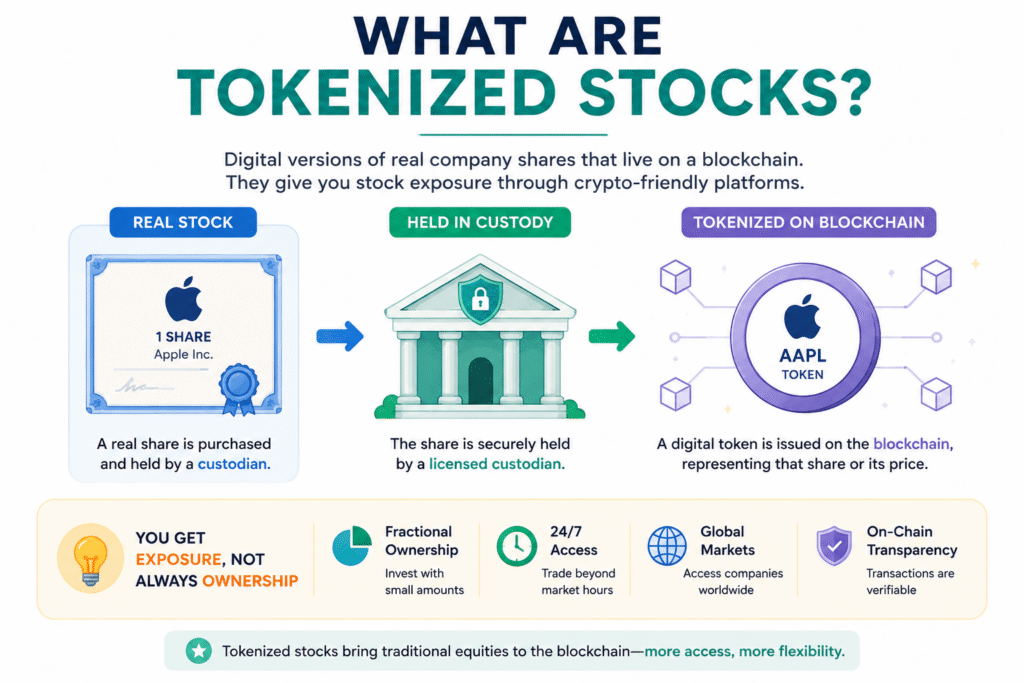
Tokenized stocks are digital versions of real company shares that live on a blockchain. They give you a way to invest in companies like Apple or Tesla through crypto-friendly platforms instead of a traditional brokerage.
Think of them as the reverse of a Bitcoin ETF. A Bitcoin ETF is a traditional investment that tracks the price of Bitcoin. Tokenized stocks flip that idea around by bringing traditional stocks onto the blockchain. The token is linked to a real share or tracks its price, depending on the platform. The difference is that ownership is recorded on-chain instead of in a broker’s database, making it easy to buy small fractions of expensive stocks.
So, why are people interested? They make investing more flexible. You can access global markets more easily, buy fractional shares, and use them within the crypto ecosystem. For investors who already use crypto, it’s a simpler way to get stock exposure without leaving the blockchain.
How Do Tokenized Stocks Work?
Tokenized stocks work by turning a real company share into a digital token that can be traded on a blockchain. While the process happens behind the scenes, buying and selling them feels much like trading any other crypto asset.
Here’s how it works:
- A licensed platform buys and holds the actual stock through a custodian, a company that safely stores the underlying shares.
- It then issues a matching digital token on the blockchain, usually following a standard like ERC-20.
- When you buy the token, you gain exposure to that stock without owning the share directly in your brokerage account.
- Smart contracts handle transfers automatically, so trades can settle much faster than in traditional markets.
- You can buy, sell, and hold them through supported platforms or crypto wallets. Some even let you keep your tokens in self-custody, giving you more control over your investments than a traditional brokerage account.
Tokenized Stocks vs. Traditional Stocks
Traditional stocks are bought through brokers during market hours, while tokenized stocks can often be traded around the clock on blockchain-based platforms.
Another key difference is accessibility. They make fractional stock ownership much easier, allowing you to invest with smaller amounts. You may also be able to hold them in your own crypto wallet instead of relying on a broker.
On the other hand, traditional stocks generally offer stronger shareholder rights and deeper liquidity and operate under well-established regulations. Tokenized securities are still a relatively new market, so regulations and investor protections can vary depending on the platform.
What Are the Benefits of Tokenized Stocks?
Tokenized stocks combine traditional investing with blockchain technology, making it easier to access and manage your investments.
- Buy fractions of expensive stocks: You don’t need enough money for a full share. You can invest with a much smaller amount.
- Trade beyond market hours: Many platforms let you buy and sell 24/7 instead of waiting for the stock market to open.
- Faster settlement: Because transactions happen on the blockchain, trades can settle much quicker than in traditional markets.
- Access global stocks more easily: You can invest in companies from other countries without relying on a local broker.
- More transparency: Every transaction is recorded on the blockchain, making it easier to verify activity.
What Are the Risks of Tokenized Stocks?
Like any investment, tokenized stocks have risks you should understand before buying.
- Regulations are still changing: Rules for tokenized stocks aren’t the same everywhere and may continue to evolve.
- Platform risk: You depend on the platform and its custodian to hold the underlying shares. If something goes wrong, your investment could be affected.
- Smart contract risk: Bugs or security flaws in the code can lead to losses.
- Lower liquidity: Some tokenized stocks don’t have many buyers and sellers, making them harder to trade quickly.
- Stock prices can still fall: Even though the token is on the blockchain, its value usually moves with the underlying stock.
- Fewer shareholder rights: Some tokenized stocks don’t give you voting rights or the same benefits as owning traditional shares.
What Are Some Real-World Examples?
Tokenized stocks already include many of the world’s biggest companies, including Tesla, Apple, NVIDIA, Amazon, and Microsoft. Among them, Tesla has consistently been one of the most popular because of its strong demand from both retail investors and crypto users.
The first widely available tokenized stocks appeared in 2020 on platforms like Mirror Protocol and FTX, although both have since shut down. Read about the FTX collapse here. Today, the market has shifted to newer platforms such as xStocks, Backed Finance, and Kraken, which offer tokenized U.S. stocks and ETFs backed by real shares or similar structures, depending on the issuer.
It’s not just individual companies, either. You can also buy tokenized ETFs, giving you exposure to a basket of stocks through a single token. As more platforms enter the market, the range of tokenized stocks available to investors is expected to keep growing.
Who Should Invest in Tokenized Stocks?
Tokenized stocks are a good fit if you already use crypto and want an easier way to invest in global companies. For example, if you’re in India and want to buy SpaceX stock, you’d normally need to open a U.S. brokerage account, complete identity checks, and navigate cross-border investing rules. With a tokenized version, you can often buy it through a crypto platform and store it in your own crypto wallet, avoiding much of the traditional brokerage process.
They’re also a good option if you’re comfortable using crypto wallets or want fractional exposure to companies like Apple or Tesla without buying a full share.
That said, if shareholder rights, deep liquidity, or investing through a highly regulated market matter most to you, traditional stocks or ETFs may still be the better choice.
How Do You Choose a Tokenized Stock Platform?
Choosing a tokenized stock platform isn’t very different from choosing a crypto exchange. The same things matter: security, fees, custody, liquidity, and whether the platform has built a strong reputation over time.
Once you’ve narrowed down your options, check whether the platform follows local regulations and clearly explains how its tokenized stocks are backed. Look into who holds the underlying shares, how custody works, and whether you can withdraw your tokens to your own wallet. Finally, compare trading fees, supported blockchains, and overall user experience before deciding where to invest.
Tokenized Stocks vs ETFs vs Direct Stock Ownership
The right option depends on what you’re trying to achieve. Tokenized stocks offer flexibility, ETFs provide instant diversification, and direct stock ownership gives you the strongest investor rights.
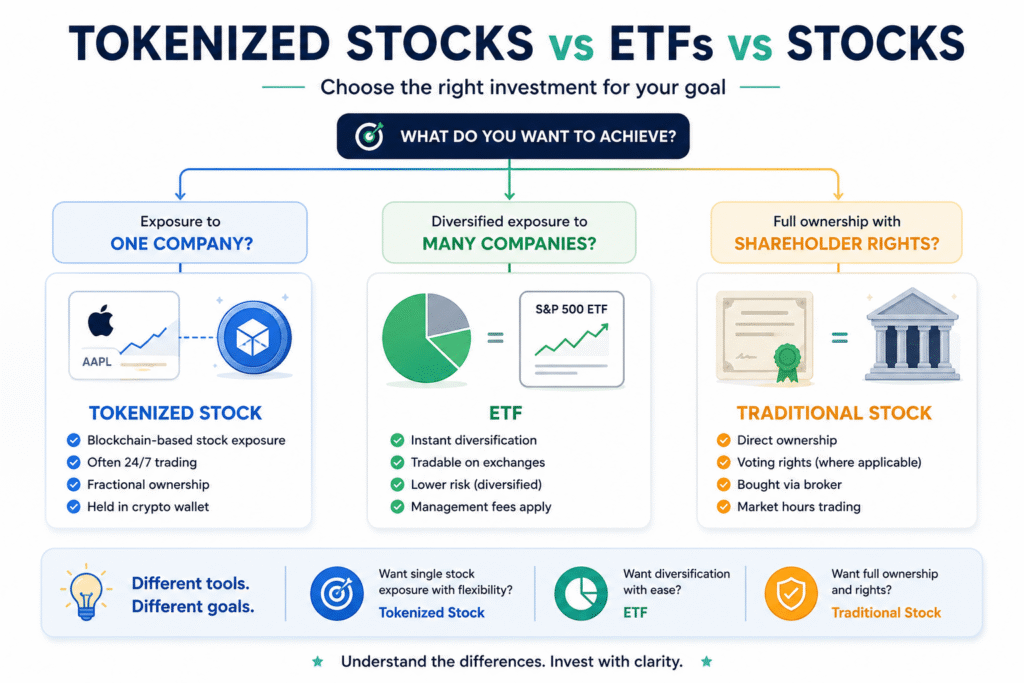
If you want exposure to a single company with features like fractional investing and, on some platforms, 24/7 trading, tokenized stocks are worth considering.
ETFs spread your money across many companies, making them a popular choice for reducing risk.
Direct stock ownership, meanwhile, gives you full shareholder rights and access to well-established markets.
ETFs are generally the easiest option for beginners, while tokenized stocks appeal to crypto users who prefer on-chain investing. Traditional stocks remain the better choice for investors who value regulation, deep liquidity, and direct ownership of company shares.
Are Tokenized Stocks Taxable?
In many countries, yes. Buying tokenized stocks isn’t usually a taxable event, but selling them for a profit often is. The exact rules depend on where you live, so it’s important to check your local tax laws. Read our country-wise crypto tax guides to learn more about local crypto tax laws.
In most cases, any profit you make when selling them may be subject to capital gains tax. If your platform passes on dividends from the underlying shares, those payments could also be taxable as dividend income. The tax treatment varies by jurisdiction and by how the platform is structured.
To make tax season easier, keep a record of your purchases, sales, transfers, and any dividend payments you receive. Good record-keeping can save time and help you report your investments accurately. Most crypto users use specialized crypto tax software, like Bitcoin.Tax, to automate tax calculations and reporting.
What Are Some Common Myths?
Tokenized stocks combine crypto and traditional finance, so they’re often misunderstood. Here are some of the most common myths.
Tokenized stocks are just cryptocurrencies: They’re digital tokens linked to real company shares or their price, not cryptocurrencies like Bitcoin or Ethereum.
Every tokenized stock comes with shareholder rights: Voting rights, dividends, and other benefits depend on the platform and how the token is structured.
Anyone can buy tokenized stocks: Availability depends on local regulations, so some platforms and countries have restrictions.
Blockchain removes investment risk: Blockchain can make trading faster and more transparent, but if the underlying stock falls, the tokenized stock usually falls too.
Frequently Asked Questions
Do tokenized stocks pay dividends?
It depends on the platform and how the token is structured. Some of them pass dividends to holders, often by automatically increasing your token balance rather than paying cash, while others don’t pass dividends on at all. Always check how the platform handles dividends before investing.
Can I transfer tokenized stocks between wallets?
In many cases, yes. If the token is issued on a public blockchain, you may be able to transfer it to another compatible wallet. However, some platforms restrict transfers to meet regulatory or compliance requirements.
Can I convert a tokenized stock into a traditional share?
Some platforms allow you to redeem them for the underlying shares or their cash value, while others don’t offer this feature. The redemption process varies by provider, so it’s important to review the platform’s terms before investing.