RWA in Crypto Explained: Tokenization of Real World Assets
RWA in crypto stands for Real World Assets. It means bringing real things like real estate, gold, stocks, or bonds onto the blockchain as tokens. This lets people buy, sell, or use those assets in crypto without dealing with traditional middlemen.
RWA in crypto is quickly becoming one of the most talked-about trends in Web3, but for many readers, it’s also one of the most confusing.
DeFi users want yield that’s more stable. Institutions want blockchain benefits without the speculative chaos. Regulators are also setting clearer rules. The real-world asset tokenization market has grown rapidly in recent years, expanding by roughly 380% over three years to about $24 billion in 2025 according to industry reports, and long-term forecasts project the broader tokenized asset market could reach $2 trillion or more by 2030.
In this guide, you’ll learn what RWA crypto really is, how real-world asset tokenization works, where yield comes from, the risks involved, and why RWAs are becoming a serious pillar of both DeFi and institutional finance.
What Are Real-World Assets (RWAs) in Crypto?
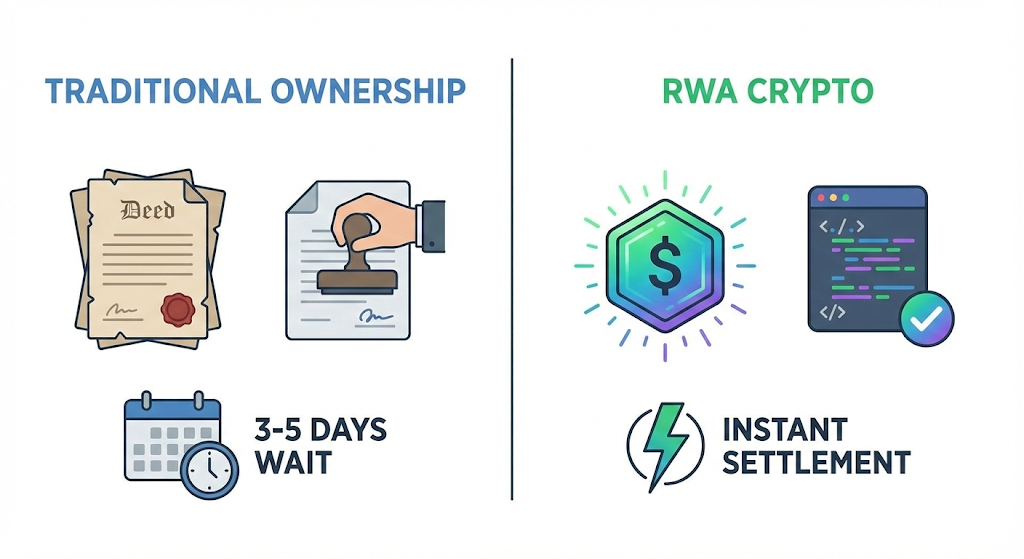
Real-world assets (RWAs) in crypto are real things, like property, bonds, or gold, that are turned into blockchain tokens. These tokens let people invest in real-world value using crypto, even though the actual asset stays off-chain.
When people ask what real-world assets in crypto are, the simple idea is this: RWAs bring real-world value into digital systems.
In the traditional world, assets live off-chain. Property records sit in government offices. Bonds stay with banks. Buying or selling them involves paperwork, delays, and multiple middlemen. RWA crypto takes a different approach by representing these assets digitally through real-world asset tokenization.
Tokenization means creating a digital token that represents ownership, or economic rights, to a real asset. That ownership can be fractional. For example, owning 1 square foot worth of tokens in an apartment doesn’t mean you can live in that space. Instead, it gives you financial exposure to the asset’s value or income. This is what tokenized real-world assets are designed for: investment access, not necessarily physical use.
So why do this at all?
Because the blockchain changes how ownership works. Ownership records, transfers, and smart contracts live on-chain. They update instantly. They’re transparent. Anyone can see them. And they don’t rely on stacks of paperwork or manual reconciliation. Trading a fraction of a building becomes as easy as sending a token.
The asset itself stays in the real world, usually held by a custodian or legal entity. But the logic around ownership moves on-chain. That shift is the real benefit, and the reason RWAs exist in crypto in the first place.
How RWA Tokenization Works (Step-by-Step)
The RWA tokenization process may sound technical, but the core idea is straightforward.
1. Asset selection and legal structuring
It starts with picking a real asset, like a building, a bond, gold, or unpaid invoices.
Before anything is tokenized, that asset is placed inside a legal structure such as an SPV (Special Purpose Vehicle), a trust, or with a licensed custodian. Think of this as putting the asset in a safe with clear ownership rules. This step makes sure the token actually represents something real. This is where compliance in RWA crypto begins.
2. Token minting and standards
Next, tokens are created on the blockchain. This is where financial asset tokenization happens.
- ERC-20 tokens are used when the asset can be split into many pieces, like bonds. Read more about ERC-20 tokens here.
- ERC-721 tokens are used for one-of-a-kind assets, like a specific property.
- ERC-3643 is made for tokenized securities and includes built-in rules about who can hold or trade them.
These tokens act as asset-backed tokens, meaning each one is tied to real value.
3. Oracles and real-world data
Blockchains don’t know what’s happening in the real world by default. That’s why oracle data for real world assets is needed. An oracle is simply a trusted data bridge that brings real-world information onto the blockchain. Oracles send updates like prices, interest payments, or proof that the asset still exists. This keeps the on-chain token aligned with reality and explains how RWAs work in crypto.
4. Distribution and secondary markets
Finally, tokens are issued to investors and can be held, traded, or used in DeFi. Some platforms are even building permissioned markets for institutions. For example, products like Aave’s Horizon Market are designed specifically to support institution-friendly tokenized debt, combining on-chain efficiency with compliance requirements.
What Types of Assets Are Tokenized as RWAs in Crypto?
The real-world assets in the crypto space aren’t limited to one asset class. Many traditional assets are already being brought on-chain to solve real problems in finance. The most common real-world assets used in crypto today fall into five categories:
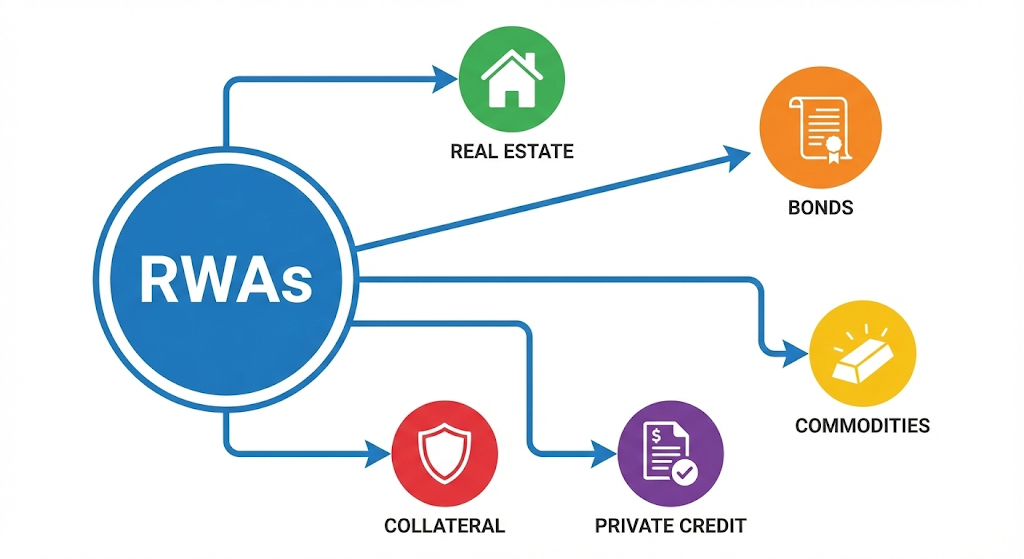
Real estate
Tokenized real estate crypto is one of the most popular RWA use cases. Property ownership is split into tokens. Instead of buying an entire apartment, investors can own a small share. This lowers entry barriers and improves liquidity in an otherwise illiquid market.
Bonds and treasuries
Tokenized bonds crypto, especially government treasuries, are gaining traction with institutions. These assets are familiar, low risk, and predictable. Putting them on-chain speeds up settlement, expands global access, and reduces paperwork. That’s a key reason institutional adoption of RWAs is growing, with the tokenized asset market rising from about $5 billion in 2022 to over $20 billion in recent years.
Commodities
Assets like gold, oil, and carbon credits are also being tokenized. Tokenized commodities blockchain projects let users gain exposure to physical goods without dealing with storage or logistics. Gold-backed tokens are a common example, where each token represents a fixed amount of physical gold.
Private credit and invoices
Private debt, trade finance, and invoices are increasingly tokenized. Businesses can turn future payments into tokens, while investors earn yield as those payments come in. This is where real world assets in DeFi starts to mirror traditional lending, backed by real cash flows.
RWAs as DeFi collateral
RWAs are often used as collateral in DeFi. Tokenized bonds or private credit can back loans, with yield coming from interest payments rather than token incentives. Compared to crypto-native assets, RWA-based yield tends to be more stable but less volatile.
Important Note: RWAs aren’t risk-free. Custody, legal, and regulatory risks still apply. But for many users, the trade-off makes RWA in crypto less about speculation and more about sustainable, real-world-backed returns.
Are RWAs legal and regulated?
In many cases, RWAs are treated the same way as their traditional equivalents. For example, if a token represents ownership in a bond, a revenue-sharing agreement, or a yield-bearing credit product, regulators often view it as a security, just in digital form.
Regulation is one of the biggest forces shaping RWA crypto, and it’s also where most confusion comes from. The key issue regulators care about is simple: what does the token represent?
You can already see this in how different regions approach similar asset classes. Here are a few examples:
- In the U.S., regulators have repeatedly said that tokenized bonds, funds, or profit-sharing assets fall under existing securities laws. If it looks like a bond or investment contract, it’s regulated like one, token or not.
- In the EU, frameworks like MiCA and existing securities laws treat tokenized stocks and bonds as “financial instruments,” meaning they must follow the same disclosure and licensing rules as traditional securities.
- Singapore has been more explicit, stating that tokenized real-world assets are regulated based on their economic function. A tokenized bond is still a bond. A tokenized fund is still a fund.
Because RWAs touch real-world finance, most projects must follow stricter rules. That often means investor checks, transfer restrictions, and identity verification. This is exactly why some DeFi platforms are building permissioned environments.
For example, Aave’s Horizon Market is designed specifically for institution-friendly tokenized debt, combining on-chain efficiency with compliance requirements. This kind of structure makes compliance in RWA crypto possible without abandoning DeFi entirely.
That’s why regulation is both a risk and a catalyst. It adds friction, but it’s also what turns RWAs from experiments into investable products at scale.
What Are the Risks of RWA Crypto?
RWAs can offer more stable returns than many crypto-native assets, but they come with their own set of risks. Most of these risks don’t come from the blockchain itself, but from how real-world assets are held, priced, and enforced off-chain.
Key risks at a glance
- Custody risk: You rely on a company or legal entity to actually hold the real asset.
- Regulatory risk: Laws can limit who can buy, hold, or trade RWA tokens.
- Oracle risk: On-chain prices and updates depend on external data sources that can be wrong or delayed.
- Smart contract risk: Code errors can affect payouts, transfers, or redemptions.
- Liquidity risk: RWA tokens may be harder to sell quickly, especially during market stress.
Custodial and counterparty risk
Most tokenized real-world assets rely on an off-chain custodian or issuer to actually hold the asset. For example, if a token represents a bond held by a trust and that trust goes bankrupt or freezes redemptions, token holders may not be able to redeem their tokens, even if the blockchain side works perfectly. This is similar to how a bank failure can affect depositors, except here it directly impacts RWA crypto holders.
Oracle and data manipulation risks
RWAs depend on oracles to report prices and asset status. If an oracle reports the wrong bond price or fails to update repayment data, DeFi protocols might overvalue or undervalue the asset. For example, a delayed oracle update could allow someone to borrow more than they should against an RWA, creating losses when prices correct. This shows how oracle data for real-world assets can become a weak link.
Smart contract risk
Even when the asset is real, the token logic is still code. A bug in a smart contract managing interest payouts or redemptions could lock funds or distribute yield incorrectly. Several DeFi exploits have shown that audited contracts can still fail. Smart contracts for RWAs reduce paperwork, but they don’t remove technical risk.
Liquidity and redemption constraints
RWAs don’t always trade like liquid crypto tokens. For example, a tokenized treasury might only allow redemptions during business hours or after a waiting period. If market demand dries up, selling on secondary markets can be slow or costly. This makes RWA liquidity more constrained than typical DeFi assets.
Frequently Asked Questions
Can RWAs be held in self-custody wallets?
In most cases, RWA crypto tokens can technically sit in a self-custody wallet. For example, you might hold a tokenized bond in your own wallet, just like any other ERC-20 token. But your legal ownership still depends on off-chain agreements. If the issuer requires KYC or limits transfers to approved investors, you may not be able to freely sell or move that token, even though it’s in your wallet. In this setup, self-custody controls the token, but the real-world rights are enforced off-chain.
What happens if the issuer of an RWA token shuts down?
If the issuer or legal entity behind a tokenized real-world asset fails, token holders may face delays or losses. Redemption depends on bankruptcy laws, custodial arrangements, and how well the asset was legally ring-fenced. This risk doesn’t exist with purely crypto-native assets.
Can RWAs be used across multiple blockchains?
Most RWAs are issued on a single chain, but cross-chain use is possible through bridges or wrapped tokens. That said, multi-chain RWAs introduce additional trust and security risks, especially around custody and verification.