What Is Avalanche? The Blockchain Built for Speed and Scale
Avalanche is a blockchain platform designed to process transactions quickly and at low cost. It supports decentralized apps, digital assets, and smart contracts, making it a popular alternative to Ethereum for developers and users.
If you’ve spent any time researching crypto beyond Bitcoin and Ethereum, you’ve probably come across Avalanche. The challenge is that most explanations either drown you in technical jargon or make the project sound like just another blockchain competing for attention.
That’s understandable. The crypto industry is crowded with Layer 1 networks all claiming to be faster, cheaper, and more scalable than the rest. Yet Avalanche has managed to stand out by building one of the largest smart contract ecosystems in crypto, attracting billions of dollars in activity across DeFi, gaming, NFTs, and enterprise applications. Its native token, AVAX, has also become one of the most widely recognized cryptocurrencies in the market.
In this guide, we’ll break down the Avalanche blockchain in plain English. You’ll learn how Avalanche works, what makes its subnet architecture different, how AVAX is used, how it compares to Ethereum and Solana, the risks to consider, and what you need to know about Avalanche taxes.
What Is Avalanche?
Avalanche is a Layer 1 blockchain designed to support smart contracts, decentralized applications, and digital assets at high speed and low cost. If you’ve ever wondered, “What is Avalanche crypto?” the short answer is that it’s a blockchain network built to process transactions quickly without sacrificing security or decentralization.
The Avalanche blockchain was launched in 2020 by Ava Labs, a company founded by computer scientist Emin Gün Sirer, along with Kevin Sekniqi and Maofan “Ted” Yin. The project was created to address a problem that many blockchains struggle with: scaling efficiently as usage grows.
This challenge is often called the blockchain trilemma. The idea is that blockchains typically find it difficult to achieve three things at the same time: security, decentralization, and scalability. For example, some networks are highly secure but expensive to use, while others are fast but less decentralized.
Avalanche was built to improve that balance. By using a different consensus approach and a unique network design, it aims to offer fast transactions, low fees, and strong blockchain security without forcing major trade-offs. Today, Avalanche is one of the leading smart contract platforms in the crypto industry.
How Does Avalanche Work?
Avalanche works by using a faster consensus system and dividing network activity across three specialized blockchains. This helps the Avalanche network confirm transactions in seconds, keep fees low, and handle far more activity than many older blockchains.
If you’ve ever tried using a blockchain during a busy period, you’ve probably seen transactions slow down and fees spike. Avalanche was built to avoid that problem. Instead of forcing one blockchain to handle everything, it splits the workload.
The X-Chain is where assets are created and transferred. The C-Chain is where most users spend their time because it’s home to smart contracts, decentralized applications, and much of the Avalanche ecosystem. Since it’s EVM compatible, many Ethereum apps can be deployed on Avalanche with minimal changes. The P-Chain works behind the scenes, coordinating validators, staking, and the network’s subnet architecture.
Think of it like an airport. Security, baggage handling, and boarding are all important, but they happen in different places. Avalanche takes a similar approach, which is a big reason why the Avalanche blockchain is known for speed and scalability.
What Makes Avalanche Unique?
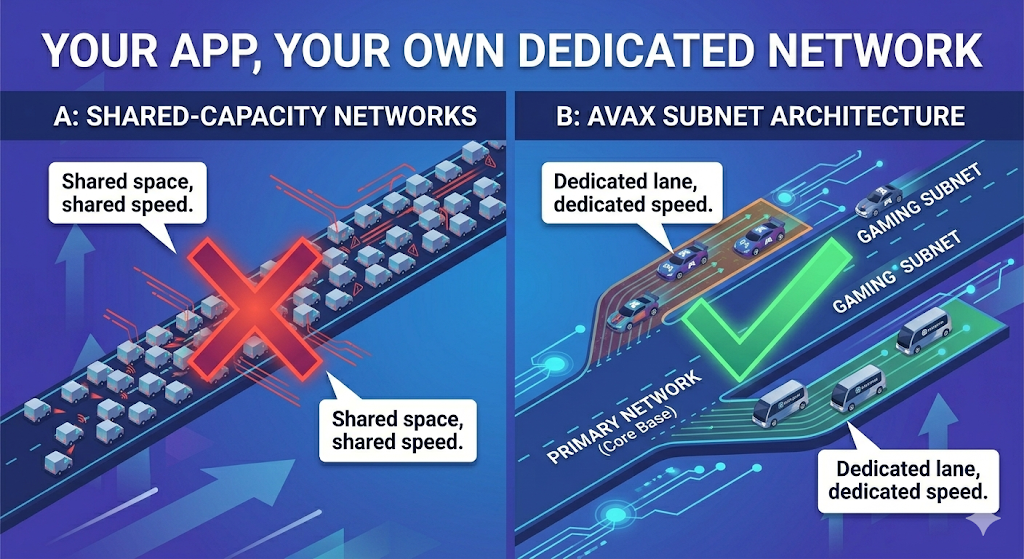
Avalanche’s biggest selling point is that it doesn’t force every project to share the same blockchain. Through a feature called subnets, developers can create their own dedicated networks while still benefiting from the broader Avalanche ecosystem. That’s very different from many Layer 1 blockchains, where every application is competing for the same block space.
This design helps Avalanche stay fast even as more users arrive. A gaming project, for example, can launch its own subnet instead of fighting DeFi apps and NFT collections for network capacity.
Developers also like Avalanche because it’s EVM compatible, which means many Ethereum applications can be moved over without starting from scratch. Add relatively low fees and an energy-efficient Proof-of-Stake model, and it’s easy to see why Avalanche has become a popular alternative to Ethereum for teams that want speed without giving up flexibility.
What Are the Key Features of Avalanche?
Avalanche is known for being fast, inexpensive to use, and flexible enough to support everything from DeFi apps to custom enterprise blockchains. Those strengths are a big reason the Avalanche network has remained one of the most popular Layer 1 blockchains.
Fast Transaction Speeds: Sending AVAX or interacting with a decentralized application typically takes seconds rather than minutes, providing a smoother user experience.
Low Transaction Fees: Avalanche fees are generally low, making smaller transactions and frequent blockchain activity more practical.
Customizable Subnets: Developers can launch dedicated blockchains tailored to specific use cases instead of competing for resources on a shared network. This is especially useful for gaming, financial applications, and enterprise projects.
Blockchain Interoperability: Tools like the Avalanche Bridge allow assets to move between Avalanche and other blockchain ecosystems more easily.
Proof-of-Stake Security: Thousands of validators secure the network through Avalanche’s Proof-of-Stake consensus mechanism, helping maintain decentralization while allowing users to earn staking rewards.
What Is Avalanche Used For?
Avalanche is used for everything from DeFi and gaming to NFTs and enterprise applications. Its combination of fast transactions and low fees has helped the Avalanche ecosystem attract developers building a wide range of blockchain-based products.
Decentralized Finance (DeFi): Platforms like Trader Joe and BENQI allow users to trade, lend, borrow, and earn yield without relying on traditional financial institutions.
Blockchain Gaming: Fast and low-cost transactions enable developers to build blockchain games without burdening players with high fees. Some gaming projects even use dedicated Avalanche subnets for customized environments.
NFTs and Digital Collectibles: Avalanche supports NFT marketplaces, creator-focused applications, and digital collectibles across its ecosystem.
Wallets and Asset Transfers: Tools like Core Wallet and the Avalanche Bridge make it easier for users to store assets, transfer tokens, and interact with the Avalanche network.
Enterprise and Institutional Solutions: Businesses and institutions are exploring Avalanche for asset tokenization, financial infrastructure, and private blockchain deployments through its subnet architecture.
What Is AVAX and What Is It Used For?
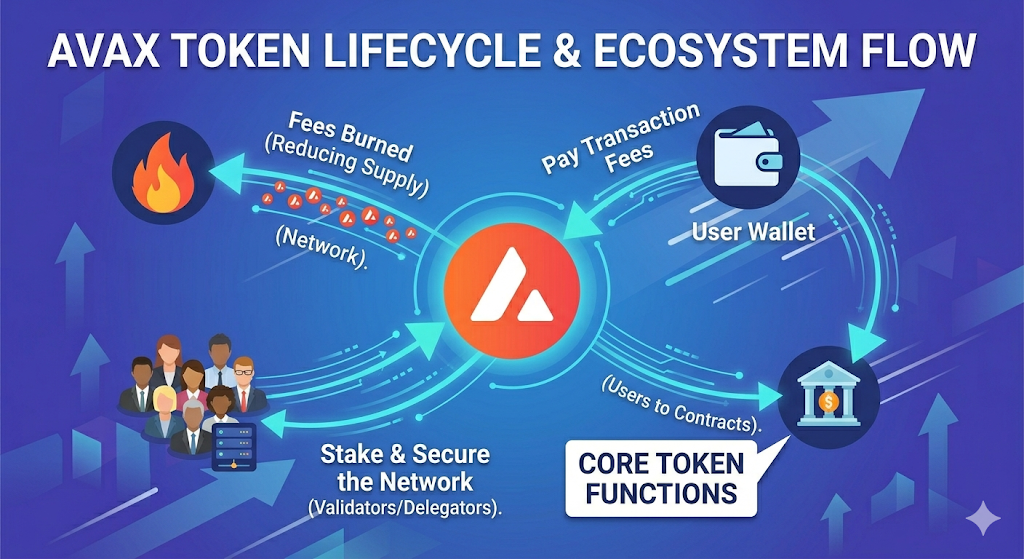
AVAX is the cryptocurrency that powers the Avalanche blockchain. If you use the Avalanche network, chances are you’ll need AVAX at some point. It’s used to pay fees, earn staking rewards, and help keep the network running smoothly.
Think of AVAX as the fuel of the Avalanche ecosystem. Whenever someone sends crypto, trades tokens, or uses an app on Avalanche, they pay a small fee in AVAX. Interestingly, those fees aren’t given to validators. Instead, they’re burned, meaning the tokens are permanently removed from circulation.
AVAX can also be staked. Validators lock up AVAX to help secure the network and earn rewards in return. Regular users can participate too by delegating their AVAX to validators and receiving a share of the rewards without running any equipment themselves.
This is also where Avalanche tokenomics comes in. As more people use the network, more AVAX gets burned, while staking encourages holders to keep tokens locked up. Together, these mechanisms play an important role in how the AVAX token works over time.
What Are the Benefits and Limitations of Avalanche?
Avalanche’s biggest strengths are its speed, low fees, and flexible subnet system. At the same time, it faces tough competition and some of the same challenges that affect many other blockchain networks.
Benefits
Fast Transaction Speeds: Transactions are confirmed quickly, helping users and applications operate with minimal delays.
Low Transaction Fees: Avalanche fees are generally affordable, making the network practical for frequent transactions and everyday use.
Customizable Subnets: Projects can launch dedicated blockchains tailored to specific use cases instead of sharing resources on a single network.
Growing Ecosystem: A strong developer community has helped expand the Avalanche ecosystem with DeFi protocols, wallets, games, and infrastructure projects.
Limitations
Strong Competition: Avalanche competes with major Layer 1 blockchains such as Ethereum and Solana for users, developers, and investment.
Decentralization Concerns: Some critics argue that validator influence could become concentrated among larger participants over time.
Market Volatility: Like the broader crypto industry, Avalanche can experience rapid changes in user activity, investment flows, and market sentiment.
Avalanche vs Ethereum vs Solana: How Do They Compare?
Avalanche, Ethereum, and Solana are all smart contract blockchains, but they take very different approaches to solving the scalability problem. Choosing between them often comes down to what you value most.
Ethereum remains the industry leader thanks to its massive developer community, deep liquidity, and mature ecosystem. The downside is that network activity can still drive up fees, which is why many users rely on Layer 2 networks. Read our guide on how to reduce Ethereum gas fees to learn more.
Solana has built its reputation on speed and low transaction costs. It’s particularly popular for trading, payments, and consumer-facing applications where users expect near-instant transactions. However, critics have occasionally raised concerns about network stability and decentralization. Read our in-depth guide on Solana to learn more.
Avalanche sits somewhere in the middle. It offers low fees like Solana while maintaining strong smart contract support and EVM compatibility. Its biggest differentiator is its subnet architecture, which allows projects to launch dedicated blockchains rather than competing for space on a single network.
In short, Ethereum wins on ecosystem size, Solana on speed, and Avalanche on flexibility. Which one is best depends on what you’re trying to build or use.
Is Avalanche Secure?
Avalanche is generally considered a secure blockchain, but like any crypto network, it is not completely risk-free. Its security comes from a large network of validators that help verify transactions and protect the blockchain through a proof-of-stake system.
To attack the network, a malicious actor would need to control a significant amount of staked AVAX, which can be expensive and difficult to achieve. At the same time, users should remember that many security incidents in crypto happen at the application level, not the blockchain level. Poorly written smart contracts, hacked protocols, and user mistakes can still lead to losses even if the Avalanche network itself remains secure.
Is Avalanche a Good Investment?
Avalanche could be a good investment if you believe more people and businesses will use the network in the future. But like any cryptocurrency, there are no guarantees, and prices can rise or fall sharply.
The main reason investors are interested in Avalanche is that it offers fast transactions, low fees, and a growing number of apps. More activity on the network could increase demand for AVAX over time. The project has also continued to attract developers and companies looking for alternatives to older blockchains.
On the other hand, Avalanche is competing with many other crypto projects for users and attention. If adoption slows or investors lose interest, the price of AVAX could struggle. As with any crypto investment, it’s important to weigh the potential upside against the risk of losing money.
Is Avalanche Taxable?
In many countries, yes. AVAX can trigger taxes when you earn staking rewards, sell your tokens, or swap them for another cryptocurrency. In general, staking rewards are often treated as income, while profits made from selling or exchanging AVAX may be subject to capital gains tax.
The exact rules depend on where you live. Some countries tax crypto heavily, while others have more favorable treatment. Because tax laws can change and vary significantly between jurisdictions, it’s a good idea to keep detailed records and consult a qualified tax professional if you’re unsure about your obligations.
Read our country-wise crypto tax guides to learn about your local crypto tax laws.
Frequently Asked Questions
Do I need AVAX to use the Avalanche network?
Yes. Just like ETH is used on Ethereum, AVAX is used to pay transaction fees on the Avalanche network. Without AVAX, you won’t be able to send assets or interact with most applications on the blockchain.
Can Ethereum applications run on Avalanche?
Many of them can. Because Avalanche is EVM compatible, developers can often move Ethereum-based applications to Avalanche without rebuilding them from scratch.
Where can I store AVAX?
AVAX can be stored in hardware wallets, software wallets, and exchange wallets. Popular options include Core Wallet, Ledger, MetaMask, and supported cryptocurrency exchanges.