14 Best DePIN Coins in 2026: Top Infrastructure Projects Ranked
The best DePIN coins power decentralized networks that run real-world infrastructure like wireless, cloud computing, storage, and data systems, rewarding users for verified contributions without centralized control.
Best DePIN coins are gaining attention as crypto investors look beyond speculation and toward real-world utility. But that creates a problem. With dozens of DePIN projects launching across storage, compute, wireless, and AI, it’s hard to tell which ones actually matter and which ones won’t survive long term.
This confusion is understandable. DePIN crypto sits at the intersection of blockchain and physical infrastructure. At the same time, demand is real. Global AI compute needs are exploding. IoT devices now number in the tens of billions. Decentralized cloud, storage, and wireless networks are no longer theoretical, they’re being used today.
This article breaks down the best DePIN coins using clear criteria, real adoption data, and practical analysis. It’s built for crypto investors, researchers, and Web3-curious readers who want exposure to infrastructure, not hype.
What Is DePIN & How It Works?
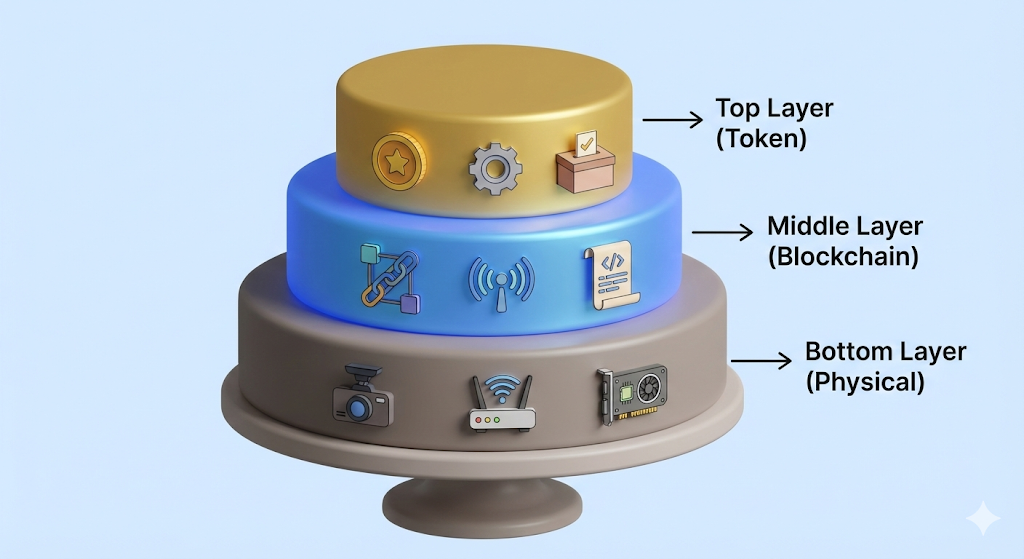
DePIN stands for Decentralized Physical Infrastructure Networks. It’s a way to build real-world infrastructure that’s owned and run by many people, not one big company. Blockchains help coordinate how the system works, so the infrastructure becomes an open network instead of a monopoly. Anyone can add resources, like hardware or services. The network checks that those resources are actually being used. When work is done, payments happen automatically through code.
In practice, this works through a layered system. Physical hardware, such as routers, GPUs, sensors, or storage devices, is deployed by users. These devices provide real services like internet coverage, compute, or data storage. A blockchain layer then coordinates the network. It handles identity, governance, rewards, and trust without a central authority. Token incentives align behavior. Contributors earn DePIN coins only when their hardware delivers verified performance. To prevent abuse, networks use verification mechanisms like proof of coverage, proof of compute, uptime checks, or peer validation.
A useful analogy is Uber or Airbnb, but without the company. People still provide the service. Rules, coordination, and payments are enforced by smart contracts instead of a platform.
Major Categories of DePIN Projects
- Wireless & connectivity: Decentralized telecom, WiFi, and IoT networks
- Compute & AI: GPU, ML, and decentralized cloud infrastructure
- Storage & data: Distributed file and data hosting
- Sensors & mapping: Location, environmental, and mobility data
- Energy & mobility: Charging networks and energy infrastructure
For a deeper technical and economic breakdown, read our full guide on DePIN crypto.
Best DePIN Coins to Invest in (2026)
In this section, we rank some of the best DePIN coins to invest in based on real-world usage, adoption, and network maturity, rather than hype alone.
1. Helium (HNT)
Helium is one of the earliest DePIN projects. It focuses on decentralized wireless networks for IoT devices and mobile connectivity. Users set up Helium hotspots that provide network coverage in their area. The blockchain checks that the coverage is real and then rewards operators with HNT tokens.
- Category: Wireless & Connectivity
- Market cap: ~$1–2B
- 24h volume: ~$10–30M
- Adoption: 900,000+ hotspots deployed globally
- Price trajectory: Peaked in 2021, corrected sharply, now trading as an infrastructure-driven asset
Helium’s scale and proven deployment make it one of the most established DePIN crypto projects.
2. Render Network (RNDR)

Render provides decentralized GPU computing for creators and AI applications. People connect unused GPUs to the network, where they are used for tasks like rendering and AI processing. In return, GPU providers are paid in RNDR tokens.
- Category: Compute & AI infrastructure
- Market cap: ~$3–5B
- 24h volume: ~$100M+
- Adoption: Used by studios, 3D creators, and AI pipelines
- Price trajectory: Strong uptrend aligned with AI demand cycles
Render is widely seen as one of the top DePIN crypto projects due to direct exposure to AI compute demand.
3. Hivemind (HIVEMIND)
Hivemind is a decentralized mapping and location data network. Users share location data, which is combined into open datasets. These datasets can be used by Web3 apps and real-world services that rely on maps and geographic data.
- Category: Sensor & Mapping
- Market cap: Low-cap / early stage
- Adoption: Growing community-run nodes
- Price trajectory: Highly volatile, early-cycle
Hivemind stands out for targeting real-world data markets, but remains higher risk due to early adoption.
4. Filecoin (FIL)
Filecoin is a decentralized storage network where people rent out unused storage space. Storage providers earn FIL tokens by storing data and proving that the data remains available over time.
- Category: Storage & Data
- Market cap: ~$3–4B
- 24h volume: ~$150–300M
- Adoption: Thousands of storage providers, enterprise usage
- Price trajectory: Long consolidation after 2021 peak
Filecoin is considered core infrastructure for Web3 storage and a long-term DePIN investment.
5. Arweave (AR)
Arweave focuses on permanent data storage. Instead of paying ongoing fees, users make a one-time payment to store data forever on the network.
- Category: Storage & Data
- Market cap: ~$1–2B
- 24h volume: ~$30–60M
- Adoption: Strong developer and archival usage
- Price trajectory: Cyclical but resilient due to niche utility
Arweave adds diversification through its unique permanent storage model.
6. Bittensor (TAO)
Bittensor supports decentralized AI training and collaboration. People contribute AI models or computing power, and the network rewards useful contributions with TAO tokens.
- Category: Compute & AI infrastructure
- Market cap: ~$4–6B
- 24h volume: ~$50–100M
- Adoption: Growing AI research participation
- Price trajectory: Strong long-term appreciation tied to AI narrative
Bittensor is one of the most prominent AI-focused DePIN projects by valuation.
7. Akash Network (AKT)
Akash is a decentralized cloud computing marketplace offering lower-cost alternatives to centralized cloud providers.
- Category: Compute & Cloud
- Market cap: ~$1–1.5B
- 24h volume: ~$20–40M
- Adoption: Increasing use for Web3 and AI workloads
- Price trajectory: Gradual growth with infrastructure adoption
AKT benefits directly from rising demand for decentralized cloud services.
8. Pocket Network (POKT)
Pocket provides decentralized access to blockchain data. It acts as a middle layer that helps apps get reliable data from different blockchains without relying on a single provider.
- Category: Data & Connectivity
- Market cap: ~$300–600M
- Adoption: Serves billions of RPC requests monthly
- Price trajectory: Underperformed price-wise despite strong usage
Pocket is often overlooked, but its real usage makes it a serious DePIN infrastructure layer.
9. Flux (FLUX)
Flux is a decentralized cloud and compute ecosystem where nodes host apps and services.
- Category: Compute Infrastructure
- Market cap: ~$200–400M
- Adoption: Steady developer usage
- Price trajectory: Volatile, mid-cycle infrastructure play
It aligns well with DePIN fundamentals but remains smaller in scale.
10. World Mobile Token (WMT)

World Mobile focuses on decentralized mobile connectivity in underserved regions.
- Category: Wireless & Connectivity
- Market cap: ~$200–300M
- Adoption: Active deployments in Africa and Asia
- Price trajectory: Early-stage, infrastructure-driven
WMT combines DePIN utility with real social impact, making it a long-term infrastructure bet.
Low-Cap & Emerging DePIN Projects to Watch
Low-cap DePIN projects can be exciting, but they’re not about quick wins. At this stage, it’s more about spotting early signals than waiting for polished products. The most promising low-cap DePIN coins usually solve a clear infrastructure problem: connectivity, compute, storage, or data.
Even small signs of progress matter. A working testnet, a few hundred active nodes, pilot programs, or early business interest are all good signs. Token design is also important. If the token is needed to run the network or use its services, that’s a stronger signal than simple price speculation. Still, there is risk. These projects take time to grow, and not all of them will succeed.
If you’re exploring upcoming DePIN crypto projects, here are a few early-stage names worth keeping an eye on, not as recommendations, but as examples of where innovation is happening:
- Hivemapper (HONEY) – Community-powered mapping using dashcams
- DIMO (DIMO) – Vehicle data network turning cars into data infrastructure
- Nodle (NODL) – IoT connectivity using smartphones and low-power devices
- Pollen Mobile (PCN) – Community-built mobile and 5G networks
DePIN Tokenomics: What Investors Must Understand
Before investing in any DePIN project, it’s important to understand tokenomics, simply put, how a token is created, distributed, and used. You can have great technology and real-world adoption, but if the token design is weak, the investment usually suffers. For investors, tokenomics decides one thing: does growing usage actually benefit token holders or not?
Start with inflation vs deflation. Inflation means new tokens are regularly created and added to supply. Deflation means supply grows slowly or even decreases. Most DePIN networks use inflation early to reward people who deploy hardware and help the network grow. That’s normal. The problem starts when too many new tokens keep entering the market without enough real demand to absorb them. Strong DePIN blockchain models reduce reliance on inflation over time.
Next are hardware incentives. DePIN only works if people are willing to install routers, GPUs, sensors, or servers. Tokens need to reward these costs upfront. But if rewards stay too high for too long, they dilute value for investors. Sustainable networks slowly lower rewards as adoption increases.
Then look at supply versus demand. When users pay for storage, compute, or data, they create real demand for the token. If usage grows alongside supply, prices can stabilize. If not, selling pressure builds.
This is why poor tokenomics can kill good DePIN ideas. Incentives must evolve with adoption.
To understand how tokenomics directly impact prices, valuations, and investor returns, read our full guide here.
Is DePIN Crypto a Good Investment?
The short answer is: it depends. DePIN is still a young space. Some experts see long-term potential. Others warn that growth will take time and patience.
The Bull Case: Why Some Experts Are Optimistic
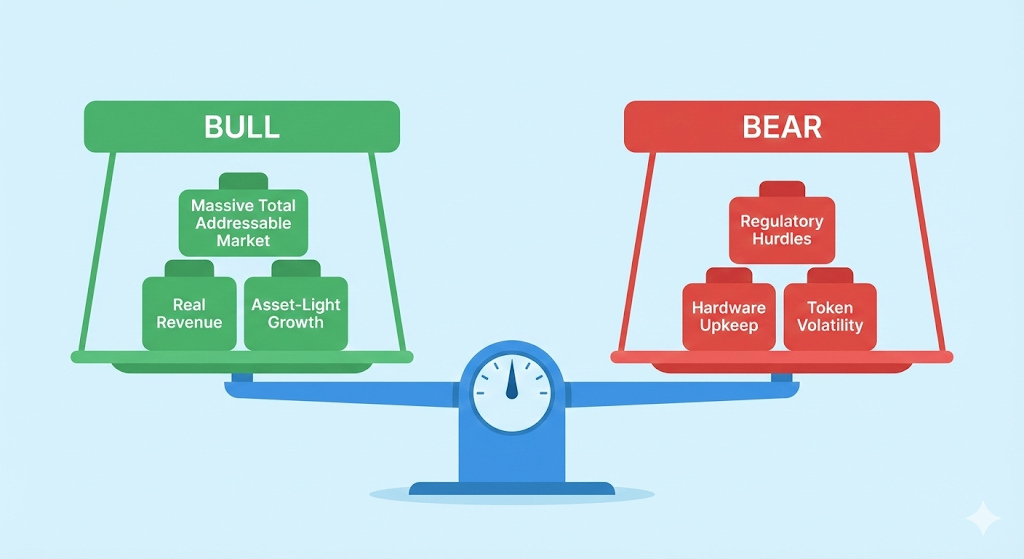
Research firms like Grayscale say DePIN connects blockchain to real-world infrastructure, things like internet access, storage, and computing power. If these networks scale, they could tap into very large markets. That’s why some long-term investors see DePIN as more than just another crypto trend.
Messari, a well-known crypto research firm, has also pointed out that DePIN projects are growing in number and adoption. More capital is flowing into the space, especially into projects building real services. The big idea here is simple: if people actually use these networks, the tokens could gain long-term value.
Many investors also like that DePIN is tied to real activity, not just speculation.
The Bear Case: Why Caution Still Matters
On the flip side, DePIN is hard to build. Real infrastructure costs money and takes time. Many networks are still early and don’t have large numbers of paying users yet. Without real demand, token prices can struggle.
Smaller DePIN tokens are also very volatile. Prices can drop sharply during market downturns. Experts often remind investors that early infrastructure projects rarely grow in a straight line.
Who Should (and Shouldn’t) Invest
DePIN may be a good fit if you are:
- Thinking long term
- Comfortable with price swings
- Interested in real-world blockchain use cases
DePIN may not be for you if you are:
- Looking for quick profits
- Uncomfortable with risk
- Investing without understanding how tokens work
How to Choose and Evaluate DePIN Projects Before Investing
Before investing in any DePIN project, it helps to slow down and run a simple reality check. Infrastructure investing is different from chasing short-term crypto trends. What matters here is usage, sustainability, and execution.
Start with real-world usage. Strong DePIN coins solve real problems. Look for live networks with people actually using the service. Whitepapers and roadmaps are easy to publish. Active deployments and real traffic matter more.
Next, check active nodes and contributors. A healthy DePIN network usually has many independent operators, not just a handful of insiders. More nodes often mean better decentralization and stronger network reliability.
Then look at token utility and incentives. The token should be necessary for the system to work. Ask basic questions. Is the token used to pay for services? Does it secure the network? Does demand grow as usage grows? This helps compare serious DePIN projects with token-only experiments.
After that, look for revenue or demand signals. Are developers, enterprises, or users paying to use the network? Even small but consistent revenue is a strong sign of long-term potential.
Also evaluate decentralization and security. Avoid projects where infrastructure, validation, or governance is controlled by a few entities. True DePIN spreads both ownership and decision-making.
Check transparency of data and metrics. Credible teams openly share node counts, usage stats, and network performance. If key data is hidden, that’s a red flag.
Finally, assess team credibility and partnerships. Public founders, regular updates, and real integrations matter far more than hype or influencer promotion.
This framework helps you spot DePIN projects built to last, not just to pump.
Where to Buy DePIN Coins Safely
Knowing where to buy DePIN coins is just as important as choosing the right project. Security and custody mistakes can wipe out gains quickly.
Start with centralized exchanges (CEXs). Major DePIN coins are often listed on large exchanges like Binance, Coinbase, or Kraken. CEXs are beginner-friendly, offer high liquidity, and handle custody for you. The trade-off is counterparty risk. You rely on the exchange to secure your assets.
Decentralized exchanges (DEXs) offer more control. You trade directly from your wallet without intermediaries. This aligns better with DePIN’s decentralized ethos. However, DEXs require more technical understanding and come with risks like smart contract bugs and fake token listings.
Next, consider wallet choices. For long-term holding, use a non-custodial wallet. Hardware wallets offer the highest security. Software wallets are convenient but should only be used with proper precautions. Check out our various lists for best wallets for more.
Follow basic security best practices. Enable two-factor authentication on exchanges. Never reuse passwords. Double-check token contract addresses before buying. Avoid clicking random links or signing unknown transactions.
In short, buy DePIN coins on reputable platforms, secure them properly, and prioritize self-custody for long-term investments.
Frequently Asked Questions
1. Are DePIN coins tied to physical assets in the real world?
Not directly. DePIN coins don’t represent ownership of hardware. Instead, they reward contributors for providing and maintaining physical infrastructure. The value comes from network usage and demand, not from tokenized assets.
2. Do DePIN projects depend on regulation in different countries?
Yes. Because DePIN networks operate in the physical world, local regulations can impact deployment. Wireless, energy, and data-focused DePIN projects often need to navigate telecom, infrastructure, or data-privacy laws, which can affect scaling speed.
3. Can DePIN projects survive without crypto incentives?
In early stages, no. Crypto incentives are essential to bootstrap participation. Long term, successful DePIN networks aim to rely more on service fees and real demand, with tokens playing a smaller but still important coordination role.