“Not Your Keys, Not Your Coins”: Explained
“Not your keys, not your coins” means that if you don’t control your crypto wallet’s private keys, you don’t truly own your coins. Keeping assets on exchanges gives the platform, not you, full control, leaving your funds exposed to hacks or freezes. A non-custodial wallet lets you hold your own keys and maintain true ownership, though there are some trade offs.
“Not your keys, not your coins” is a phrase you’ve probably heard, but what does it actually mean, and why does it matter so much in 2025?
Here’s the hard truth: millions of crypto users still keep their assets on exchanges, trusting platforms that can be hacked, frozen, or even collapse overnight. After the FTX meltdown, over $8 billion in customer funds vanished, and just in 2024 alone, more than $1.7 billion worth of crypto was lost to hacks and security breaches.
If you’ve ever wondered whether your crypto is truly safe, you’re not alone. Many investors don’t realize that without control of their crypto private keys, their coins aren’t really theirs.
This guide breaks everything down, from what “Not your keys, not your coins” really means to how crypto self-custody works, why it matters, and how to safely store your assets long-term.
What Does “Not Your Keys, Not Your Coins” Mean?
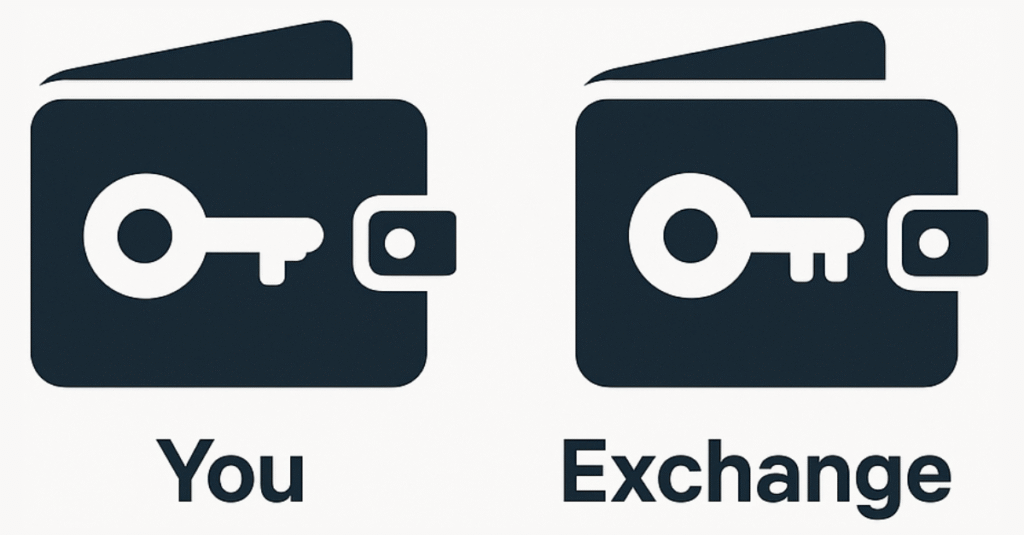
The phrase “Not your keys, not your coins” sums up the core idea of crypto ownership: the one who controls the private keys controls the funds.
A crypto wallet has two parts: a public address that others can send crypto to, and a private key that proves the assets belong to you. If someone else holds that key, they control the coins. Not you.
This is why storing crypto on centralized exchanges, like Binance or Coinbase, works differently than holding it yourself. When you leave your assets on an exchange, the exchange is the one holding the private keys. Your balance appears under your name, but the platform has the final authority over those funds. It’s convenient and beginner-friendly, but it also means your access depends on their policies, security, and uptime.
A non-custodial wallet removes that dependency. Here, you hold the private keys directly, so your crypto is truly yours. No one can freeze it, restrict it, or move it without your permission. Most decentralized exchanges let you trade straight from your non-custodial wallet, using smart contracts to handle the transaction. Your coins never leave your control.
Read our in-depth guide on custodial vs non-custodial wallets to learn more.
The trade-off is that you’re responsible for keeping those keys safe. Lose them, and there’s no recovery system. So the choice comes down to what you value more.
If you’re trading often and want speed and simplicity, keeping some funds on an exchange can make sense. But for long-term storage, financial independence, and real ownership, a non-custodial wallet is the better home.
In the end, it’s simple: if you don’t hold the keys, you’re trusting someone else to hold your money.
What Happens When You Don’t Own Your Keys
Here are some real-world examples of what can go wrong if you don’t hold your own keys:
FTX Collapse
When FTX, one of the world’s biggest crypto exchanges, imploded in 2022, millions of users lost access to their funds overnight. It turned out that customer deposits were being misused behind the scenes, and when the exchange went bankrupt, withdrawals were frozen.
Read the full story here.
Users who trusted FTX with their assets couldn’t move or recover their coins because they didn’t hold their private keys. This was a brutal reminder that even big, “trusted” platforms can fail.
Celsius and BlockFi Freeze
Shortly after the market downturn in 2022, lending platforms like Celsius and BlockFi also froze user withdrawals. Many investors learned too late that their deposits were being lent out or used as collateral.
The platforms called it “temporary,” but those funds were effectively gone for months, and in some cases, forever.
Exchange Hacks and Data Breaches
Beyond collapses, exchange hacks have always been one of the biggest threats in crypto. Mt. Gox in 2014, Coincheck in 2018, and countless smaller breaches since all tell the same story.
Even well-secured exchanges can become targets for hackers. And when they do, user funds are often part of the fallout.
Read more about the biggest crypto hacks here.
Benefits of Self-Custody
Now that we have discussed what can go wrong, let’s talk about some benefits of holding your own keys.

True Ownership and Financial Sovereignty
Self-custody means you, and only you, decide how, when, and where to move your assets. There’s no exchange, government, or third party that can block, freeze, or censor your transactions.
Reduced Exchange and Regulatory Risk
Keeping funds on exchanges exposes you to counterparty and regulatory risks. One government order, bankruptcy, or hack can freeze billions of dollars overnight, as seen during the FTX collapse and Celsius freeze.
By holding your own keys, you bypass these risks entirely. Your assets are stored directly on the blockchain, not in a company’s custody. Even if every exchange went offline tomorrow, your crypto would still be safe in your non-custodial wallet.
Direct Access to DeFi and Web3
One of the biggest benefits of self-custody is that it unlocks the full potential of DeFi and Web3. When you control your crypto private keys, you can directly connect your wallet to decentralized apps, from lending platforms and staking protocols to NFT marketplaces and DAOs, without needing permission from an exchange.
This means you can earn yields, vote in governance, and explore new blockchain ecosystems safely and directly. Self-custody isn’t just about storage, it’s about participation. It gives you the freedom to engage with crypto as it was meant to be: open, decentralized, and user-controlled.
Risks & Responsibilities of Self-Custody
When you hold your own crypto private keys, you become your own bank. And that means if something goes wrong, there’s no customer support to call.
Key Loss = Loss of Funds
If you lose your private keys, you lose your coins. There’s no recovery email or password reset, and the blockchain only recognizes whoever holds the keys.
Millions in Bitcoin and other assets have been lost forever because users misplaced their seed phrases or forgot their private keys. If you self-custody, you must have a reliable system for seed phrase security. More on this later.
Social Engineering and Phishing Risks
Hackers rarely attack blockchains directly. Instead, they target users through phishing scams and social engineering. Fake wallet apps, malicious links, and impostor “support” chats can all trick you into revealing your seed phrase or private keys.
Following best practices, like verifying websites, using hardware wallets, and never entering your seed phrase online, greatly reduces these risks. In self-custody, your biggest defense is awareness and skepticism.
Read our in-depth guide on protecting your crypto assets to learn more.
May be Overwhelming for Beginners
For beginners, keeping a small amount on a reputable exchange can be practical while you learn. Exchanges handle the technical side, making it easier to trade and explore. But long term, as your understanding and portfolio grow, shifting toward non-custodial wallets becomes essential.
How to Self-Custody Safely
Here’s a practical checklist to help you protect your assets, whether you’re storing Bitcoin, Ethereum, or any other token.
1. Generate Your Seed Phrase Offline
Always create your seed phrase offline, ideally using a hardware wallet or a trusted open-source wallet on a disconnected device. Avoid generating it on your phone or computer while connected to the internet. This prevents malware or phishing attacks from intercepting it.
2. Use Hardware Wallets
A hardware wallet, like Ledger or Trezor, is one of the safest ways to store your crypto. These devices keep your private keys offline, isolated from the internet, and protected even if your computer gets hacked.
Check out our full list of best crypto hardware wallets.
3. Secure Your Seed Phrase (No Screenshots!)
Your seed phrase is your lifeline. Never save it digitally. Not in photos, not in notes, not in the cloud. Instead, write it down on paper or, even better, store it on a metal backup. Fireproof and waterproof metal plates are excellent for long-term storage. Keep multiple backups in separate, secure locations.
4. Test the Recovery Process
Before you move large sums, test your seed phrase recovery. Create a new wallet using your seed phrase on a different device and verify that it restores your balance correctly.
5. Plan for Long-Term Storage vs. Daily Use
Not all wallets serve the same purpose.
- Long-term holdings: Use a cold wallet (offline storage) such as a hardware device or paper wallet. Ideal for savings and large investments.
- Daily spending: Use a hot wallet (connected to the internet) for smaller amounts you need to access quickly.
What if I lose my keys?
If you lose your private keys and don’t have your seed phrase, your crypto is gone, permanently. The blockchain can’t restore it. Recovery is only possible if your seed phrase still exists, which lets you rebuild your wallet on another device. Some new social recovery wallets are emerging, but they’re still experimental. And remember, anyone claiming they can “recover” your wallet for you is almost certainly a scam.
When NOT to Self-Custody
There are scenarios when using an exchange or custodial service actually makes more sense. Here’s when you might want to hold off on full self-custody.
1. If You Trade Frequently
Active traders benefit from keeping funds on a reputable exchange since it offers faster execution, better liquidity, and lower network fees. Constantly moving crypto between non-custodial wallets and exchanges can be inefficient and costly. However, it’s still wise to keep only what you trade online and store the rest securely offline.
2. If You Lack Backup Discipline
Self-custody requires strong habits for managing crypto private keys and seed phrase security. If you’re prone to forgetting passwords or misplacing important information, you risk losing permanent access to your funds. Until you’ve built reliable backup routines, sticking with a custodial wallet is safer.
3. If You’re New and Starting with Small Test Amounts
Beginners often find crypto self-custody overwhelming, from understanding cold vs hot wallets to avoiding phishing links. It’s perfectly fine to start with a trusted exchange, buy small amounts, and learn how transactions work. Once you’re confident, move a portion to a non-custodial wallet.
Quick Beginner Setup Guide
Here’s a simple, no-stress way to start your self-custody journey safely.
1. Start with a Software Wallet
Begin with a non-custodial software wallet like MetaMask, Trust Wallet, or Phantom. These are great for beginners and give you direct control of your crypto private keys without needing extra hardware.
Once you’re comfortable managing your seed phrase and making small transactions, graduate to a hardware wallet like Ledger or Trezor for stronger protection.
Check out our full list of best non-custodial crypto wallets for more.
2. Deposit Small Amounts First
Always start small. Move a small portion of your crypto from an exchange to your new wallet, just enough to test the process. This way, if you make a mistake during setup or transfer, your losses are minimal.
3. Backup and Test Restore
Back up your seed phrase, offline, on paper or metal, and store it somewhere secure. Then, test it. Create a new wallet and use your seed phrase to restore your funds.
Tax Implications of Self-Custody
Whether your coins sit on an exchange or in a non-custodial wallet, your tax liability remains the same. What matters is the type of transaction, not where your crypto is stored.
Transferring your crypto from an exchange to a personal wallet doesn’t count as selling or disposing of your assets. It’s just moving your own funds. So, moving coins between your own wallets isn’t taxable, as long as the wallets belong to you.
Check out our country-wise crypto tax guides to learn more about your local crypto tax laws.
One small downside of self-custody is that exchanges usually keep detailed transaction histories, which makes crypto tax reporting simpler. When you manage your own wallets, you’ll need to track transactions manually, every send, receive, or trade.
If you use multiple wallets, keeping consistent records is crucial. Tools like Bitcoin.Tax or similar platforms can automate the process by syncing wallet data and generating reports.
Pro Tip: Keep Transaction Logs
No matter where you store your coins, maintain a personal transaction log. Record wallet addresses, transfer dates, and amounts, even for self-transfers. It will save you time (and stress) during tax season and help you verify cost basis if ever audited.
FAQs
1. Is self-custody safe for large amounts of crypto?
Yes, but only if you follow proper crypto wallet security practices. Using hardware wallets, keeping your seed phrase offline, and testing recovery backups make self-custody extremely secure, even for large holdings.
2. Can I use multiple wallets for better security?
Absolutely. Many crypto holders use multiple wallets, a cold wallet for long-term storage and a hot wallet for smaller, daily transactions. Diversifying storage adds an extra layer of protection.
3. What happens if my hardware wallet breaks?
If your hardware wallet is lost or damaged, you can restore your funds using your seed phrase on a new device. The coins aren’t stored on the wallet itself; they live on the blockchain. Your seed phrase is the real key to recovery.
4. Are mobile wallets safe for everyday use?
Yes, for small amounts. Mobile non-custodial wallets like Trust Wallet or MetaMask are convenient for payments or quick swaps. But since they’re always online, they’re more vulnerable to hacks or phishing.